
TL;DR
Laidback Gardener published a Halloween-themed report on Oct. 1, 2026, about gelatinous fungi that can appear on dead wood around homes in Quebec. It describes orange witch’s butter, black jelly roll and yellow brain, including how some shrink in dry weather and swell again after rain. The source says they are harmless to touch, but does not provide broader identification or foraging guidance.
Laidback Gardener published a Halloween-themed report on Oct. 1, 2026, introducing readers to three gelatinous fungi that may appear on dead wood around homes in Quebec. The report describes how some of these fungi shrink during dry weather and swell after rain, making them easy to overlook until damp conditions return.

Get pool and patio gear delivered free with Prime
- Fast, free delivery on millions of items
- Prime Video, Amazon Music and more included
- Member-only deals all year
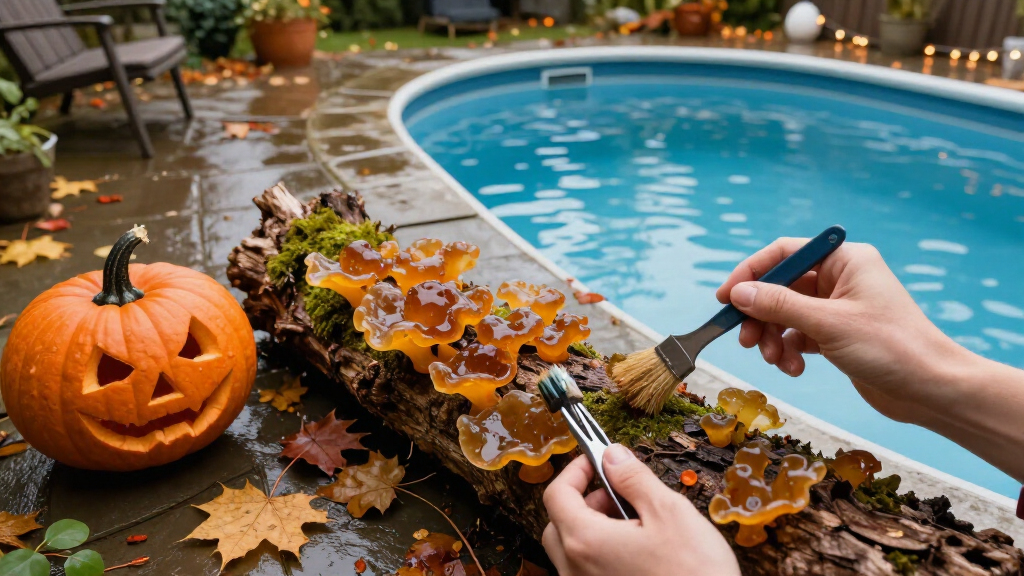
The report focuses on orange witch’s butter (Dacrymyces chrysospermus), which grows on dead conifer wood, including old fences, posts and decayed lumber. According to the article, it can look like a small orange patch when dry and become a shiny, swollen mass in damp conditions. It also describes black jelly roll (Exidia glandulosa), found on dead hardwood branches. The fungus forms glossy black blobs when wet and dries into a thin crust.
The third example, yellow brain (Tremella mesenterica), is described as a folded, golden-yellow mass. The article says it does not feed directly on the wood where it appears; instead, it parasitizes other fungi growing inside the wood. The report stresses that “jelly fungi” is a descriptive label, not a single closely related group: gelatinous texture has evolved independently among different fungi.
In the report, the return of these fungi to a swollen state after drying is called “reviviscence.” It says a number of species shrivel into a hard crust or leathery film when conditions are dry, then expand after rain. The article presents this as a seasonal garden observation, rather than a new scientific study or a change in public safety guidance.
The report draws attention to a small but noticeable change in gardens after autumn rain: fungi on dead wood can look very different when wet from how they appear during a dry spell. That helps explain why a glossy, conspicuous growth may seem to have appeared suddenly even if it was present as a shriveled crust beforehand.
For readers, the main value is identification and awareness. The examples show that not every fungus resembles a conventional capped mushroom, and that a shared common label does not establish close biological relationship. The article also separates appearance from edibility: it notes that some jelly fungi may be labeled edible, but its author says they are not appealing to eat. That personal reaction is not a recommendation about what is safe to forage.
Products Worth Considering

Philips Hue Play Gradient Light Tube, Large, Black

Ring Alarm 8-Piece Kit (Newest Model) – Home Security System

Roborock Qrevo S Pro Robot Vacuum and Mop with 18,500 Pa Suction
As an affiliate, we earn on qualifying purchases.
Three Fungi in Quebec Gardens
The article is the author’s annual October excursion into unusual organisms found in gardens, presented as a playful Halloween special. It combines seasonal humor with descriptions of fungi readers may encounter on dead branches, old posts or decaying wood. Its geographic framing is Quebec; the source does not claim that the three examples occur only there.
The report also offers a sensory comparison for the fungi’s texture: a party balloon lightly coated with vegetable oil, described as firm, elastic and slippery. That analogy is illustrative, not a scientific measurement. The article’s central biological point is that moisture changes their visible form, while the label “jelly fungi” groups organisms by texture rather than by a single shared lineage.
““jelly fungi” aren’t actually a single group.”
— Laidback Gardener report
Limits of the Garden Report
The source is a seasonal report, not a field survey. It does not provide counts, prevalence data or a comparison across years, so it cannot establish whether jelly fungi are becoming more common or how frequently each species appears in Quebec yards. It also does not give a complete identification guide or confirm that every gelatinous fungus readers encounter is one of the three named species.
The article describes the examples as harmless to touch, but it does not set out detailed handling advice or evaluate risks for every species. Its comments about edibility are not a foraging guide. Readers should not infer that an unfamiliar fungus is safe to eat or handle solely because it looks similar to one described in the report.
Watch for Changes After Rain
The report points readers toward a simple way to observe these fungi: check dead wood during dry weather, then look again after rain, when some growths may become more visible. No follow-up study, new identification release or additional reporting milestone is announced in the source. Whether readers will see the named species depends on local conditions and what fungi are present in their area.
Key Questions
What does “jelly fungi” mean?
It is a descriptive label for fungi with a gelatinous texture, not the name of one closely related group. The report says the texture evolved independently among fungi.
Which fungi does the Halloween report describe?
It features orange witch’s butter (Dacrymyces chrysospermus), black jelly roll (Exidia glandulosa) and yellow brain (Tremella mesenterica).
Why do some jelly fungi seem to appear after rain?
The report says some shrink into a crust or leathery film in dry conditions and swell again when damp. The change can make them much easier to see after rain.
Does the report recommend eating jelly fungi?
No. The author says some are labeled edible but expresses a personal reluctance to eat them. The article is not a foraging safety guide; do not eat a wild fungus based on this report.
Source: rss