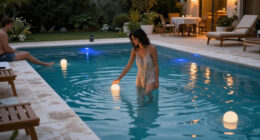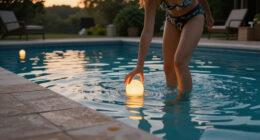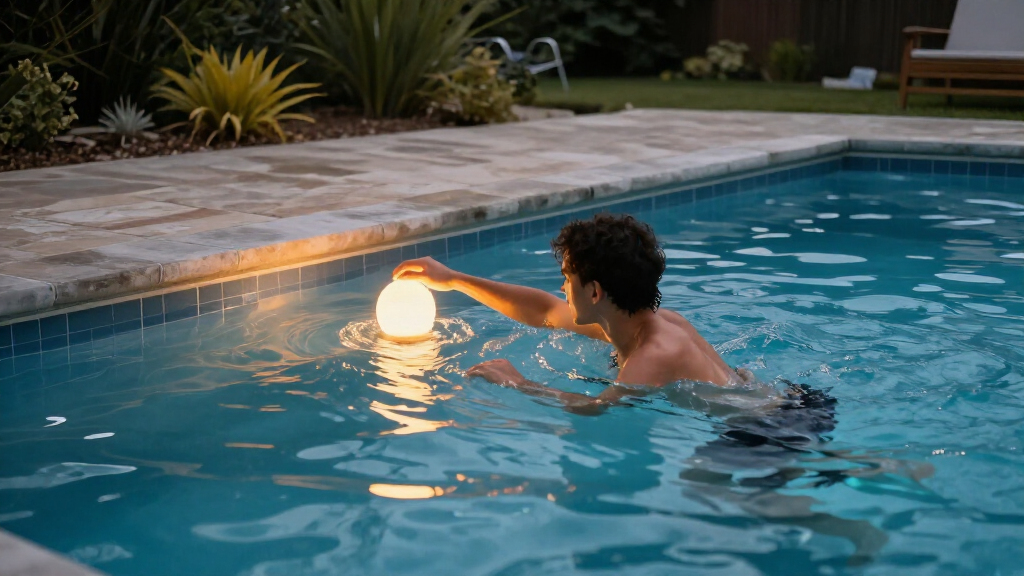

Solar and rechargeable floating LED pool lights solve the same basic problem: adding light to the water without installing a permanent fixture. The real choice is whether you would rather let daylight replenish the lights or charge them yourself for more control over when they are ready. Solar models suit pools that get strong sun and owners who value low-maintenance operation; rechargeable models fit evening plans, shaded yards, or anyone who wants more predictable performance. Brightness, runtime, upkeep, weather exposure, and long-term cost all affect which option makes sense.

Get pool and patio gear delivered free with Prime
- Fast, free delivery on millions of items
- Prime Video, Amazon Music and more included
- Member-only deals all year

LENONE Floating Pool Lights with Remote – 6.5" RGB Color Changing Solar Light, IP68 Waterproof, Hangable for Pools, Gardens and O…
- ✔ Power: Solar powered
- ✔ Water resistance: IP68; description specifies submersion up to 30 minutes
- ✔ Brightness: 1500 lumens (listed)

Solar Powered Floating Pool Lights (2 Pack) with Remote Control, 12 Lighting Modes, Timer, IP67 Waterproof for Pools, Baths & Gar…
- ✔ Pack size: 2 lights
- ✔ Power: Solar powered
- ✔ Water resistance: IP67

Floating Pool Lights – 4 Pack, 4000 mAh, 7 Colors, 6 Modes, IP68
- ✔ Pack size: 4 lights
- ✔ Power: 4000 mAh USB-C rechargeable battery
- ✔ Charging time: 4 hours for a full charge
At a Glance
| Criteria | Solar floating LED pool lights | Rechargeable floating LED pool lights | Winner |
|---|---|---|---|
| Power and charging | Charges from sunlight; performance depends on sun exposure | Charges from a wall outlet or USB, depending on model | Depends |
| Brightness and consistency | Often modest and variable, especially after cloudy days | More predictable after a full charge; varies by product | B |
| Runtime | Can vary with sunlight and selected mode | Specified by the manufacturer, though modes affect runtime | B |
| Upkeep and convenience | No routine manual charging, but panels need daylight and cleaning | Requires charging before use and managing battery condition | A |
| Features and control | Usually basic color or lighting modes | Often offers more modes, remote control, or timers | B |
| Weather and durability | Must be sealed and rated for poolside outdoor use | Must be sealed and rated for poolside outdoor use | Tie |
| Long-term value | Low operating cost; best value with frequent sun exposure | Higher upfront cost may pay off with reliable use and stronger features | Depends |
LENONE Floating Pool Lights with Remote – 6.5" RGB Color Changing Solar Light, IP68 Waterproof, Hangable for Pools, Gardens and O…
The LENONE is the most straightforward choice when we want one floating light to act as a vivid focal point. Its listed 1500-lumen output and 6.5-inch diameter give it a more substantial presence than a small decorative puck, while the remote offers seven colors and 16 modes. Compared with the Kitloo two-pack, it puts the emphasis on one brighter centerpiece rather than spreading light across two locations. That makes it a good fit for a compact pool, a spa corner, or a garden pond where one point of color is enough.Solar charging keeps the setup simple: there is no battery pack to replace or cable to connect before each use. The tradeoff is that it needs 8–10 hours of sunlight for a full charge, so cloudy weather or a shaded pool deck may leave less light for the evening. The product description also says it can be submerged for up to half an hour, so we would follow the maker’s instructions rather than assume unrestricted underwater operation from the IP68 label alone.There are practical limits to the single-unit approach. One light cannot create the distributed effect of the Kitloo pair or the synchronized four-pack, and a floating unit can drift unless it is tethered or hung. Choose LENONE when brightness and simple remote color changes matter more than broad coverage; skip it if we want several lights to stay coordinated around a larger pool.
Pros:
- Listed 1500-lumen output suits a noticeable single-light accent.
- Remote provides seven colors and 16 lighting modes.
- Solar powered, with no routine battery replacement.
- Can be hung as well as floated, offering placement flexibility.
Cons:
- Full charging is stated to require 8–10 hours of sunlight.
- One unit offers less distributed coverage than the two- and four-light sets.
- May drift unless tethered or hung.
Best for: Pool owners who want one bright, solar-powered color accent for a compact pool, spa, or water feature.
Not ideal for: Buyers who need broad, even coverage, synchronized lights, or reliable evening use after several cloudy days.
Bottom line: We choose LENONE for a bright, flexible centerpiece when one solar light is enough and sunlight is dependable.
“We choose LENONE for a bright, flexible centerpiece when one solar light is enough and sunlight is dependable.”
Solar Powered Floating Pool Lights (2 Pack) with Remote Control, 12 Lighting Modes, Timer, IP67 Waterproof for Pools, Baths & Gar…
The Kitloo set makes more sense when we want light in two parts of a pool or spa without buying into the larger four-unit setup. Each of the two solar lights has 30 LED beads, and the included remote offers 12 modes split between dynamic RGB effects and static colors. Two floating points can make the water feel more evenly decorated than the LENONE’s single bright focal point, though the supplied details do not give a lumen figure for a direct brightness comparison.Its strongest practical difference is the 4-, 6-, or 8-hour timer. That lets us choose a run window and avoid leaving the lights on longer than needed, a control neither of the other listed options matches in the same way. Solar charging keeps daily setup cable-free, but it still depends on available daylight. The IP67 rating is also a step below the IP68 ratings listed for LENONE and the four-pack, so we should follow the product’s placement guidance rather than infer that all three have identical submersion suitability.Kitloo is the value-oriented pick for buyers who prioritize two lights and scheduled shutoff. Its setup has a small learning wrinkle: the remote requires removal of an insulating sheet before use. It also lacks the four-pack’s group sync and stated runtime, and its solar charging is less predictable than charging the USB-C option ahead of time. Choose it for straightforward, spread-out color with a timer; look elsewhere if coordinated effects or a defined long runtime are central to the plan.
Pros:
- Two lights provide more placement options than a single unit.
- Timer choices of 4, 6, or 8 hours help manage operating time.
- Each unit lists 30 LED beads and 12 RGB lighting modes.
- Solar charging avoids routine battery replacement.
Cons:
- Charging and evening performance depend on sufficient sunlight.
- IP67 rating is lower than the IP68 ratings listed by the other options.
- Remote requires removing an insulating sheet before use.
Best for: Buyers who want two solar lights with a timer for a pool, bath, or garden feature.
Not ideal for: Those who need IP68-rated products, a published runtime, or synchronized control across a larger group.
Bottom line: We recommend Kitloo when two solar lights and a practical timer matter more than synchronized control or a stated runtime.
“We recommend Kitloo when two solar lights and a practical timer matter more than synchronized control or a stated runtime.”
Floating Pool Lights – 4 Pack, 4000 mAh, 7 Colors, 6 Modes, IP68
For a larger pool or a deliberately coordinated look, this four-pack offers the broadest placement options in the lineup. Its Group Sync function lets multiple units change color and mode together, so we can create a unified display rather than manage each light separately. The remote is specified for up to 165 feet in open air, which can help when the pool is distant from the seating area, though actual range may vary with obstructions. Compared with Kitloo’s two solar units, this set is built around a larger group and synchronized control.USB-C charging gives the lights a different kind of convenience from the solar picks: we can prepare them in advance without relying on a sunny day. A four-hour charge is stated to provide 10–12 hours of illumination, and 2- or 4-hour auto-off options help limit operation. That defined charging routine is useful for planned evening use, but it means keeping track of the charge and connecting the lights between occasions. LENONE is simpler when the sun can do the work, while this set is more predictable when the weather is uncertain.The tradeoffs are specific. The remote itself is not waterproof, so it needs to stay dry at the poolside, and the four listed LEDs per unit do not come with a lumen figure to compare with LENONE’s stated output. Buyers seeking one exceptionally bright floating centerpiece may prefer LENONE; those who want a few coordinated color points and can manage charging will get more flexibility here. We would pick this set for group effects and planning, while acknowledging that four units may be unnecessary for a small spa.
Pros:
- Four lights and Group Sync support a coordinated multi-point display.
- USB-C charging avoids dependence on sunlight.
- Listed runtime is 10–12 hours after a four-hour charge.
- Remote is specified for up to 165 feet in open air.
Cons:
- The remote is not waterproof and must be kept dry.
- A full charge requires a four-hour charging session.
- No lumen figure is supplied for comparison with LENONE.
Best for: Owners of larger pools or water features who want several lights to change modes together and can charge them before use.
Not ideal for: Buyers who prefer solar-only charging, need a waterproof remote, or want one high-output focal light for a small spa.
Bottom line: We choose this set for planned, synchronized lighting across a larger pool when USB-C charging is practical.
“We choose this set for planned, synchronized lighting across a larger pool when USB-C charging is practical.”
As an Amazon Associate we earn from qualifying purchases.
Key Differences
The most meaningful difference is control over available power. Solar lights trade predictability for convenience: they can charge while sitting in the sun, but cloudy weather, shade, short winter days, or a late start can leave them dim or depleted when the pool is in use. Rechargeable lights let you prepare ahead, so their output is less dependent on the weather. That advantage matters most for planned evening swims or gatherings, though runtime still varies by model and lighting mode.
That greater control can come with a higher purchase price and a recurring charging task. Solar is often the better value for a sunny pool used casually, especially if basic ambient light is enough. Rechargeable models make more sense when dependable brightness, color options, timers, or remote controls will be used regularly. Neither type is a substitute for code-compliant pool safety lighting or supervision; check the product’s water and outdoor ratings, and follow the manufacturer’s instructions for charging and use.
Detailed Comparison
Power and charging (Rechargeable floating LED pool lights wins — moderate)
Solar lights collect energy from sunlight, so they need suitable exposure and may charge poorly in shade or cloudy conditions. Rechargeable lights need an outlet or USB connection, but charging ahead of time gives you more control over readiness. Rechargeable wins for planned use; the difference is moderate because charging convenience depends on whether a suitable sunny spot is available.Brightness and consistency (Rechargeable floating LED pool lights wins — moderate)
Solar models often prioritize low energy use, and their output can fall when they have not received much sun. Rechargeable models are more likely to deliver the expected brightness after a full charge, although actual performance depends on the specific light and its mode. Rechargeable wins by a moderate margin for people who want the pool visibly lit rather than softly accented.Runtime (Rechargeable floating LED pool lights wins — moderate)
Solar runtime is tied to the energy gathered during the day, making it harder to predict from one evening to the next. Rechargeable lights usually list an estimated runtime after charging, giving owners a clearer basis for planning. Rechargeable wins for predictability, but check whether the quoted runtime applies to the brightest setting; the gap is moderate.Upkeep and convenience (Solar floating LED pool lights wins — moderate)
Solar lights can recharge where they float or sit in a sunny spot, avoiding a regular plug-in routine. They still need adequate sun, occasional panel cleaning, and storage care. Rechargeable models require charging and battery care, but can be ready on a schedule. Solar wins for lower day-to-day effort in a sunny location; this is a moderate advantage that shrinks in shade.Features and control (Rechargeable floating LED pool lights wins — minor)
Many solar lights focus on automatic or basic color effects. Rechargeable models more often include multiple modes, timers, or remote controls, though features vary widely. Rechargeable wins by a minor-to-moderate margin if you will use those controls; for simple ambient lighting, extra modes may add little practical value.Weather and durability (minor difference)
Both types spend time near water and face sun, rain, and pool chemicals, so the housing and seals matter more than the power source. Look for clear water-resistance and outdoor-use ratings, and follow guidance on chlorine or saltwater compatibility. Neither option has a general advantage; the difference is minor and product-specific.Long-term value (moderate difference)
Solar lights usually cost less to operate and can be economical when they receive dependable sun. Rechargeable lights may cost more initially, but their predictable output and added controls can justify the price if they see frequent use. Neither wins for every pool: solar is better value for casual use in a sunny yard, while rechargeable can be better value for regular, planned evening lighting.Solar floating LED pool lights: Pros and Cons
Pros:
- No routine plugging in when the lights get enough sunlight
- Low operating cost
- Convenient for casual ambient lighting in sunny yards
Cons:
- Charging and brightness depend on sun exposure
- Shade and cloudy weather can reduce readiness
- Often offers fewer controls than feature-rich rechargeable models
Rechargeable floating LED pool lights: Pros and Cons
Pros:
- Can be charged ahead of a planned swim or event
- More predictable output after a full charge
- May include more lighting modes, timers, or remote controls
Cons:
- Needs a charging routine and access to a compatible charger
- May cost more upfront
- Runtime still changes with brightness and mode
Who Should Choose What
Choose Solar floating LED pool lights if:
- Your pool area gets strong sun for much of the day.
- You want simple accent lighting and do not need the same brightness every night.
- You prefer low operating costs and minimal charging chores.
Choose Rechargeable floating LED pool lights if:
- You plan evening swims or gatherings and want lights ready on schedule.
- Your yard is shaded or often cloudy.
- Brightness, runtime expectations, or lighting controls matter more than avoiding plug-in charging.
Skip both if: Skip both if you need dependable, code-compliant illumination for pool safety or swimming after dark; floating accent lights may not provide the coverage or certification required. Consider properly installed pool lighting and follow local rules.
Value for Money
Pay more for a rechargeable model when you will use its predictable charge, stronger output, or extra controls often enough to notice them. For occasional use in a sunny yard, solar usually offers better value because it avoids routine charging and ongoing power use. Compare the actual charging method, stated runtime, water-resistance rating, and warranty before treating a higher price as evidence of better performance. A modest solar light that suits your expectations can be a better purchase than a feature-heavy rechargeable one you rarely use.
Final Verdict
For most owners who want dependable lighting for a specific evening, rechargeable floating LED pool lights are the stronger choice: charge them beforehand and their readiness does not depend on that day’s sun. Choose solar if your pool gets reliable daylight, you want easy ambient lighting, and you value low-maintenance operation more than consistent output. The deciding factor is whether convenience means avoiding charging or knowing the lights will be ready when planned. Pay extra for rechargeable features only if you will use the added control or brightness; neither style should be relied on as a safety-lighting system.
Frequently Asked Questions
Are solar or rechargeable floating pool lights brighter?
Rechargeable models are more likely to deliver consistent brightness after a full charge, but brightness varies by product. Solar output can depend on how much sunlight the light received that day. Compare published brightness specifications and reviews for the exact models rather than relying on the power type alone.
How long do floating LED pool lights stay on?
Runtime depends on the light’s battery or solar charge, brightness setting, and lighting mode. Rechargeable products may list an estimated runtime after a full charge; solar models can vary with daylight. Treat manufacturer figures as estimates and check which mode they describe.
Can floating LED lights replace pool safety lights?
Do not assume they can. Floating lights are commonly designed for decorative or ambient use and may not provide required visibility or meet local safety rules. Check local requirements and use properly rated pool lighting where needed.
Are rechargeable pool lights worth the higher price?
They can be worth paying more for if you need reliable readiness for planned use, your pool area is shaded, or you will use features such as timers and remote controls. For occasional decorative lighting in a sunny yard, solar is often the better value.
Black Friday Picks

Philips Hue Amarant Outdoor Smart Light Bar, Black
As an affiliate, we earn on qualifying purchases.