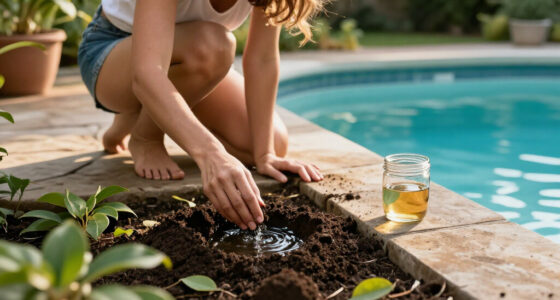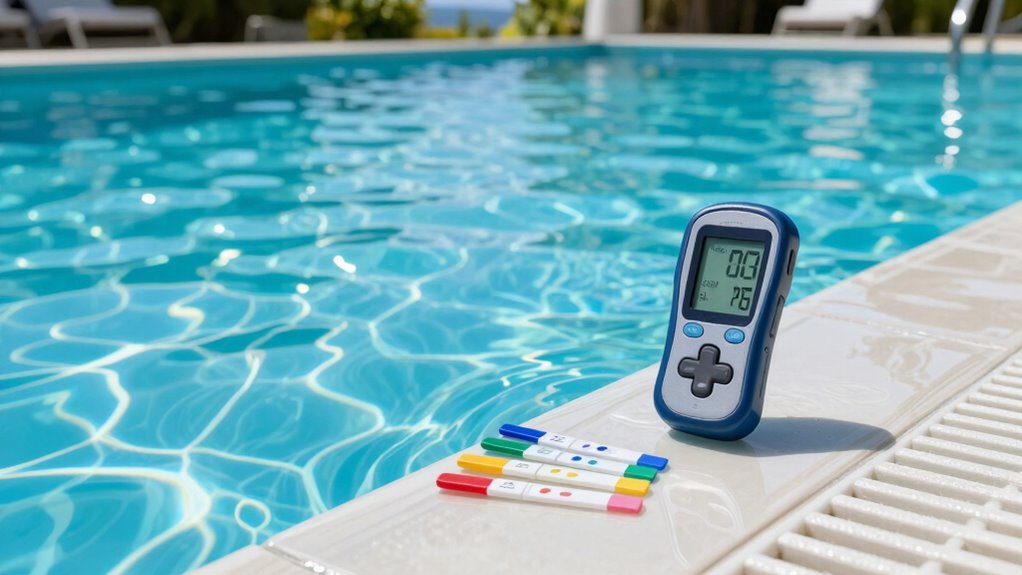

To quickly grasp pool water balance, focus on regularly testing key parameters like pH, alkalinity, and sanitizer levels using simple test kits or digital testers. Make small adjustments gradually and maintain consistent testing at least twice a week. Keep your equipment clean and functioning properly to guarantee even chemical distribution and clear water. If you stay consistent with these basics, you’ll keep your pool safe and inviting—there’s plenty more to explore if you want to master it.

Get pool and patio gear delivered free with Prime
- Fast, free delivery on millions of items
- Prime Video, Amazon Music and more included
- Member-only deals all year
Key Takeaways
- Focus on regularly testing pH, alkalinity, and sanitizer levels to understand water chemistry trends quickly.
- Use simple test kits or digital testers for instant, easy-to-interpret results.
- Maintain consistent equipment checks and cleaning to support stable water balance.
- Adjust chemical levels gradually based on test results, avoiding the need to memorize detailed chemistry.
- Follow a routine maintenance schedule to keep water quality predictable and manageable.
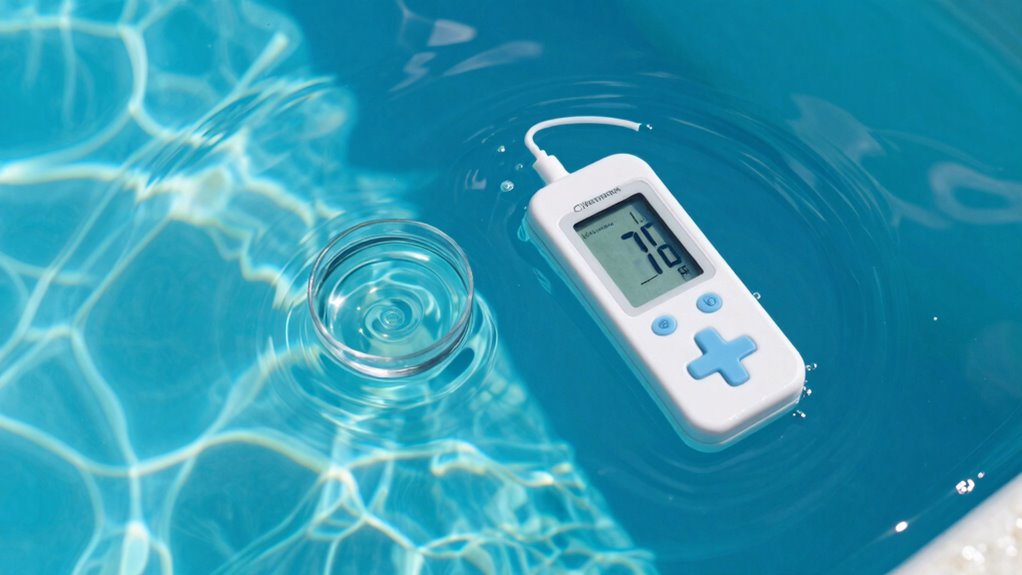
Have you ever wondered why your pool water looks crystal clear and feels just right? The secret lies in maintaining the perfect water balance, which involves more than just adding chemicals or turning on equipment. It’s about understanding how chemical adjustments and equipment maintenance work together to keep your pool inviting and safe. You don’t need to memorize complex formulas or get overwhelmed by technical jargon—there’s a straightforward way to grasp the essentials.
Start by recognizing that maintaining water balance is a balancing act involving pH, alkalinity, calcium hardness, and sanitizer levels. When you make chemical adjustments, you’re fine-tuning these components to work harmoniously. For example, if your water’s pH is too high, it becomes cloudy and can cause scaling on your pool surfaces. If it’s too low, it can cause corrosion and skin irritation. Adjusting pH is simple: you add pH increasers or decreasers, but the key is to do it gradually, testing your water regularly. Alkalinity acts as a buffer, preventing pH swings, so maintaining proper alkalinity levels helps stabilize the entire system. Additionally, water chemistry plays a crucial role in preventing issues like algae growth and bacteria buildup. Keeping an eye on chemical balance is essential for a healthy pool environment. Regular testing and understanding these interactions help you maintain a stable and safe swimming environment.
Balancing pH and alkalinity keeps your pool clear, safe, and comfortable. Regular testing makes it simple.
Equipment maintenance plays an equally vital role. Your pool’s filtration system, pump, and skimmers work together to remove debris, distribute chemicals evenly, and keep water circulating. When your equipment runs efficiently, it helps distribute chemicals uniformly, reducing the need for constant adjustments. Regularly cleaning filters, checking for leaks, and ensuring your pump operates correctly prevent issues like cloudy water or algae growth. Proper circulation also ensures that chemicals stay evenly dispersed, which is fundamental for balanced water. Analyzing equipment performance can help identify potential issues before they escalate. Staying on top of these equipment checks can help you catch potential issues early before they impact water quality.
The best way to keep everything in check without feeling overwhelmed is to establish a routine. Test your water at least twice a week using simple test kits or digital testers. These tools give you quick insights into pH, alkalinity, and sanitizer levels, guiding your chemical adjustments. Simultaneously, inspect and maintain your equipment monthly, cleaning filters and verifying that your pump and skimmers are functioning at their highest standard. This proactive approach minimizes surprises and keeps your pool water crystal clear. Building a consistent maintenance schedule ensures that your pool remains inviting and safe for everyone.
Products Worth Considering

Philips Hue Essential Starter Kit – Bridge and 4 E26 Smart Bulbs

Shark Rotator Lift-Away Upright Vacuum with HEPA Filter (NV501)

eufy Security SoloCam E42 4-Camera Kit, 4K Solar Security Cameras with HomeBase 3
As an affiliate, we earn on qualifying purchases.
Frequently Asked Questions
How Often Should I Test My Pool Water?
You should test your pool water at least twice a week to maintain proper water chemistry. Regular testing helps catch imbalances early, preventing issues like algae growth and corrosion. During heavy use or after storms, test more often. Keep a pool maintenance routine that includes checking pH, chlorine levels, alkalinity, and stabilizer. Consistent testing guarantees your water stays clear, safe, and balanced for enjoyable swimming.
What Are the Signs of Unbalanced Pool Water?
Imagine your pool as a delicate dance floor; signs of unbalanced water are the missteps. You’ll notice cloudy water, algae growth, or a strange smell, all signs of disrupted chemical reactions. Sharp eye on pH fluctuations reveals the dance’s rhythm is off, causing irritation or corrosion. If your water feels slimy or your skimmer struggles, it’s time to tune up your pool’s chemistry for smooth sailing.
Can I Fix Water Imbalance Without Chemicals?
Yes, you can fix water imbalance without chemicals by using natural filtration techniques and DIY adjustments. Start by running your pump longer to enhance natural filtration, encouraging beneficial bacteria to balance the water. You can also add natural clarifiers like algae or enzyme-based products, and manually adjust pH with baking soda or vinegar. Regularly brushing and skimming the pool helps maintain clarity, reducing the need for chemical treatments.
How Do Temperature Changes Affect Water Balance?
Think of your pool water as a delicate dance, where temperature fluctuations act as unpredictable partners. As water warms or cools, pH stability can shift, throwing off the balance. Higher temperatures often speed up chemical reactions, making it harder to maintain correct pH levels. To keep the dance smooth, monitor temperature changes closely and adjust chemicals promptly, ensuring your water stays balanced and inviting, no matter the season.
What Equipment Helps Maintain Proper Water Balance?
You need specific equipment to maintain proper water balance. A reliable pool filtration system keeps debris out and helps with water clarity, while proper water circulation guarantees chemicals distribute evenly. Consider using a pump with adjustable speed settings, a skimmer, and a return jet system. Regularly check and maintain your filtration equipment, as it’s essential for healthy water chemistry and preventing issues like algae growth or cloudy water.
Conclusion
Now that you’ve revealed the secrets of pool water balance, you’re like a modern-day alchemist turning ordinary water into crystal-clear perfection. Remember, just as a captain steers through calm and stormy seas, maintaining your pool’s pH, alkalinity, and calcium hardness keeps your oasis inviting and safe. With a little attention and routine checks, your pool will be as inviting as a siren’s call, ready to welcome swimmers into your personal paradise—no wizardry needed.