To quickly estimate how much salt your new pool needs, start by calculating its volume based on the shape and dimensions—such as length, width, and depth. Use the formula for your pool type, like length × width × average depth × 7.5 for rectangular pools, then determine how many pounds of salt are needed to reach the recommended 3,000 ppm concentration. Accurate measurement helps avoid over- or under-salting. Keep going to discover detailed steps to perfect your salt level setup.
Key Takeaways
- Determine your pool’s volume accurately using shape, dimensions, and the formula for precise salt calculations.
- Check current salt levels with reliable test strips or digital testers before adding salt.
- Calculate the required salt amount based on your pool volume and the target ppm (usually 3,000).
- Spread salt evenly around the pool perimeter and turn on circulation to ensure quick dissolution.
- Regularly test and adjust water chemistry during salt addition for accurate and safe salt levels.
Maintaining the correct salt levels in your pool is vital for guaranteeing a safe and balanced swimming environment. When you’re setting up a new salt pool, estimating how much salt to add can feel overwhelming. The key is to understand your pool’s size and the target salt concentration, typically measured in parts per million (ppm). This initial step is fundamental for proper water chemistry, as too much or too little salt can disrupt your pool’s balance and affect the effectiveness of your salt chlorinator.
Maintaining proper salt levels is essential for a safe, balanced, and inviting pool environment.
To get started, you’ll need your pool’s volume, which you can calculate based on its shape and dimensions. For example, a rectangular pool’s volume is found by multiplying length × width × average depth × 7.5. Once you have this figure, you can determine the amount of salt needed by referencing the recommended salt concentration—usually around 3,000 ppm for most salt systems. Many pool supply stores and manufacturers provide simple calculators or charts that specify how many pounds of salt to add per 1,000 gallons to reach that concentration. Using these tools guarantees you’re estimating accurately and helps you avoid adding too much salt at once.
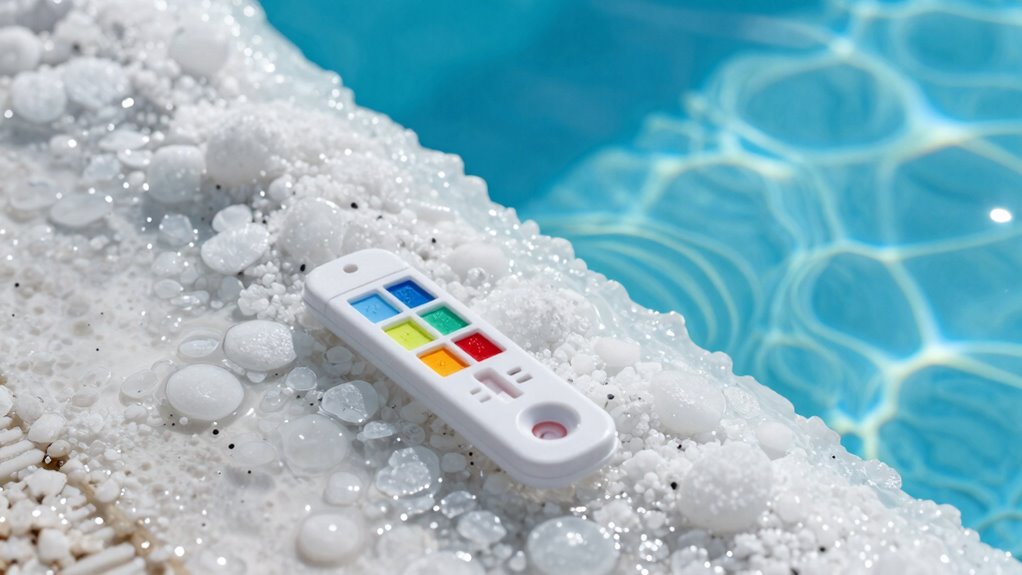
Next, you should test your water’s current salt level with a reliable salt test strip or digital tester. If your water is fresh, it should read zero or very low. Based on this reading, you can calculate the precise amount of salt to add. For example, if your pool holds 10,000 gallons and you want to reach 3,000 ppm, you’ll need approximately 150 pounds of salt. To simplify, some manufacturers suggest adding a certain amount of salt per 1,000 gallons to reach the desired level, making calculations straightforward. Additionally, understanding the importance of biodiversity in natural water systems can help you appreciate the significance of maintaining balanced water chemistry. Properly measuring and adjusting salt levels can also prevent corrosion of pool equipment, which is a common issue when salt concentrations are improperly managed. Regular testing of your water during this process is essential to ensure accuracy and avoid over- or under-salting. Furthermore, keeping an eye on water chemistry parameters helps optimize the effectiveness of your chlorinator and prolongs equipment lifespan.
As you add the salt, do it gradually, spreading it evenly around the pool’s perimeter to facilitate dissolution. Turn on your pool’s pump to circulate the water, which helps distribute the salt evenly throughout the pool. Keep testing the water chemistry regularly during this process to monitor the salt levels and guarantee they stay within the ideal range. Once the salt reaches the target ppm, you can fine-tune your water chemistry by adjusting pH, alkalinity, and stabilizer levels as needed. Proper pool maintenance depends on maintaining balanced water chemistry, which in turn prolongs your equipment’s life and keeps your pool inviting.
As an affiliate, we earn on qualifying purchases.
Frequently Asked Questions
How Often Should I Test My Salt Levels?
You should test your salt levels weekly to guarantee ideal pool water quality. Evaporation can alter salt concentrations, so regular testing helps maintain proper levels. Keep an eye on salt distribution patterns, especially after refilling or adding chemicals, to prevent uneven salt accumulation. Consistent testing allows you to adjust salt levels promptly, ensuring your salt pool stays balanced, safe, and inviting for swimmers.
What Type of Salt Is Best for My Pool?
For ideal pool maintenance and balanced salt water chemistry, choose high-purity, food-grade salt specifically designed for pools. Avoid salts with additives like anti-caking agents or iodine, as they can affect your water quality. Using the right salt guarantees your saltwater system runs efficiently, prevents corrosion, and keeps your pool crystal clear. Always follow your pool manufacturer’s recommendations for salt type and maintain proper salt levels for the best results.
Can I Use Regular Table Salt?
You shouldn’t use regular table salt in your pool because it contains additives like anti-caking agents that can disrupt pool chemistry. Instead, choose high-purity, pool-specific salt. When converting salt levels, remember that table salt’s sodium content differs from pool salt, affecting salt conversion calculations. Using proper pool salt guarantees your pool’s chemistry stays balanced, preventing corrosion or scaling, and maintaining safe, clean water.
How Do Outdoor Conditions Affect Salt Requirements?
Outdoor obstacles, like environmental impact and seasonal shifts, greatly influence your salt needs. Hotter, sunnier days increase evaporation, lowering salt levels, so you must supplement more salt. Cooler or rainy seasons dilute salt concentrations, requiring less salt addition. You should always make seasonal adjustments, considering outdoor conditions. Keep a close eye on your pool’s salt levels, and adapt your additions to ensure your salt pool stays perfectly balanced, regardless of outdoor changes.
What Are Signs of Low or High Salt Levels?
You’ll notice signs of low salt levels if your pool’s salt concentration drops, causing the salt cell to struggle and the sanitizer to become less effective. High salt levels may lead to cloudy water, corrosion, or equipment issues. Water evaporation can also affect salt concentration, making it seem lower than it truly is. Regular testing helps you monitor salt levels, ensuring they stay within the ideal range for safe, clean swimming.
digital salt water tester for pools
As an affiliate, we earn on qualifying purchases.
As an affiliate, we earn on qualifying purchases.
Conclusion
Just like tuning a radio to find the perfect station, estimating your salt needs is about precision and patience. I once added too much salt to my pool, turning it into a salty lagoon—an expensive mistake! Remember, starting with the right estimate saves you time and money, ensuring your pool’s crystal-clear, just like a perfectly tuned radio. Follow these quick steps, and you’ll have a sparkling, balanced pool in no time.
As an affiliate, we earn on qualifying purchases.
As an affiliate, we earn on qualifying purchases.