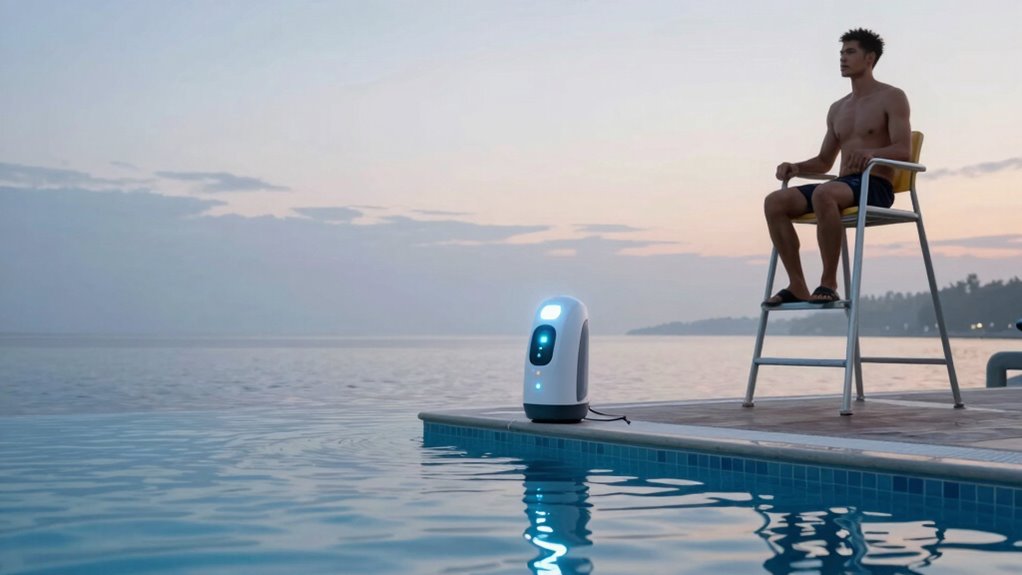

Drowning detection technology helps you by providing quick alerts when someone is in distress, supporting your safety protocols and reducing response times. It constantly monitors activity, giving early warnings to enable prompt action. However, it’s important to remember it doesn’t replace your judgment or quick decision-making. Human oversight is still essential to assess situations accurately and respond effectively. Keep exploring to discover how combining technology with trained personnel creates the safest environment.

Get pool and patio gear delivered free with Prime
- Fast, free delivery on millions of items
- Prime Video, Amazon Music and more included
- Member-only deals all year
Key Takeaways
- Technology provides early alerts to prompt human intervention, enhancing response times without replacing human judgment.
- Human oversight is essential to interpret alerts accurately and make rapid, situational decisions.
- Drowning detection systems support safety protocols but rely on trained personnel for effective emergency responses.
- Combining technology with human action ensures adaptability to real-world conditions and reduces false alarms.
- Proper training and maintenance maximize system benefits while emphasizing the continued importance of human vigilance.
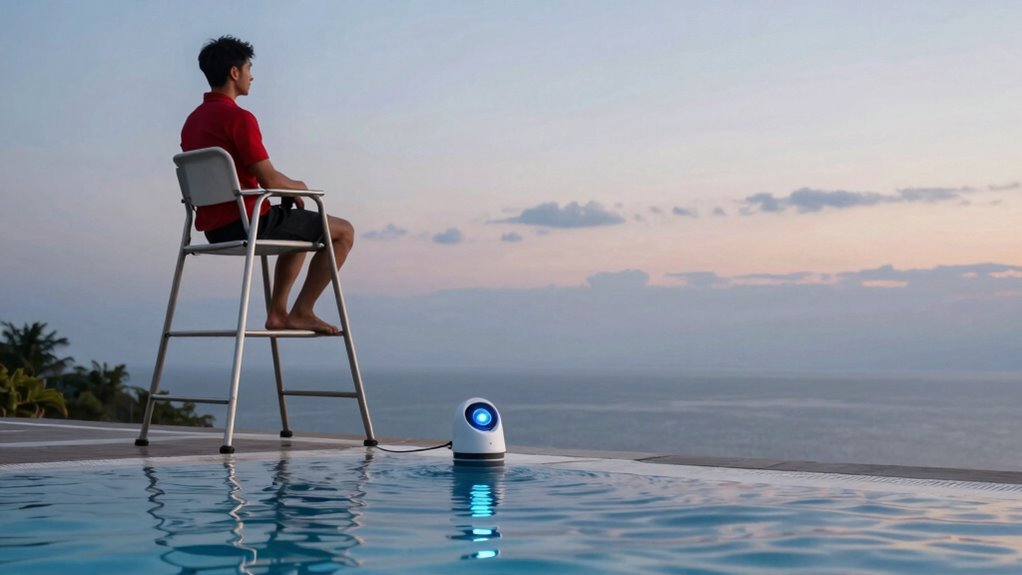
Drowning detection technology has become an indispensable tool for enhancing safety in swimming pools, beaches, and other aquatic environments. These systems are designed to alert staff quickly when a swimmer is in distress, enabling prompt action. However, while this technology provides valuable assistance, it should never replace the importance of human attention. Instead, it supports your safety protocols by serving as an additional layer of security, helping to prevent tragic incidents before they escalate.
When you’re around water, maintaining constant human supervision is critical, but even the most vigilant lifeguards or supervisors can experience distractions or fatigue. Drowning detection systems act as an extra set of eyes, constantly monitoring activity and sounding alarms if they detect signs of distress. This allows you and your team to respond faster than you might on your own, especially during busy times when keeping 100% focus can be challenging. These systems don’t replace the need for trained personnel; instead, they reinforce your emergency response plan, ensuring no incident goes unnoticed.
It’s important to understand that technology alone cannot guarantee safety. Human judgment, quick decision-making, and a proactive safety protocol are irreplaceable. When an alert sounds, it’s your responsibility to assess the situation rapidly and execute your emergency response procedures effectively. Drowning detection technology merely provides early warnings, giving you precious moments to intervene before a situation worsens. This synergy between technology and human action minimizes risk and creates a safer environment for everyone in the water. Additionally, understanding the capabilities and limitations of drowning detection technology helps ensure it is used effectively as part of a comprehensive safety plan. Recognizing these technology limitations can help prevent over-reliance and ensure proper safety measures are always in place. Incorporating human oversight remains essential to adapt responses based on real-world conditions and nuances that technology might not interpret correctly.
Furthermore, technology can help reduce response times. Instead of relying solely on visual surveillance, which might be hindered by glare, poor visibility, or fatigue, alarms prompt immediate attention. This proactive approach can be the difference between a rescue and a tragedy. Still, your role remains crucial. You must be trained to interpret alerts correctly, differentiate false alarms, and act swiftly according to established safety protocols. Your presence and awareness ensure that the technology’s benefits translate into tangible safety outcomes. Moreover, ongoing training and familiarization with the system’s features are vital to maximize its effectiveness and accurately respond to alerts, which aligns with the importance of proper training and maintenance.
drowning detection system for pools
As an affiliate, we earn on qualifying purchases.
As an affiliate, we earn on qualifying purchases.
Frequently Asked Questions
How Accurate Are Drowning Detection Systems in Different Water Conditions?
Drowning detection systems’ accuracy depends on water visibility and sensor calibration. In clear water, they tend to perform well, catching most incidents quickly. However, poor visibility or murky conditions can reduce their effectiveness. Regular sensor calibration is essential to maintain accuracy across different water conditions. While these systems are helpful, you should always stay alert, as environmental factors can influence their reliability.
What Are the Limitations of Current Drowning Detection Technologies?
You should know that current drowning detection technologies face limitations like sensor reliability issues, especially in challenging water conditions, which can lead to false alarms. These systems may struggle with differentiating between real emergencies and benign movements, causing unnecessary alerts. While advancements are ongoing, these limitations mean human supervision remains essential to guarantee accurate detection and swift response, as technology alone can’t yet assure complete safety.
How Do Privacy Concerns Impact Drowning Detection Device Usage?
Are you willing to trade some privacy for safety? Privacy concerns considerably impact your use of drowning detection devices, as privacy trade-offs and data security become top priorities. You might worry about sensitive footage or personal data being accessed or misused. These concerns can lead to hesitations in adopting the technology, even though it offers essential lifesaving support. Balancing safety benefits with privacy rights is key to trusting and effectively using these devices.
Can Drowning Detection Systems Be Integrated With Existing Safety Protocols?
Yes, drowning detection systems can be integrated with existing safety protocols through automated monitoring, which allows for real-time alerts to emergency response teams. You can set up these systems to seamlessly communicate with lifeguards or emergency services, ensuring immediate action when a threat is detected. This integration enhances safety measures, making responses quicker and more efficient while complementing human oversight rather than replacing it.
What Training Is Required for Staff to Use Drowning Detection Technology Effectively?
Think of staff training as tuning a finely crafted instrument—you need to master the notes for harmony. You’ll focus on technology familiarity, learning how to interpret alerts and operate systems confidently. Practical drills and hands-on practice make your skills second nature, ensuring swift, accurate responses. Ongoing education keeps your knowledge sharp, so you can act decisively and support safety effectively, turning technology into a trusted extension of your vigilant eye.
lifeguard alert and monitoring system
As an affiliate, we earn on qualifying purchases.
As an affiliate, we earn on qualifying purchases.
Conclusion
Drowning detection technology is a valuable tool that enhances safety, but it’s not a substitute for human vigilance. Remember, studies show that over 50% of drowning incidents occur when lifeguards are distracted or overwhelmed. By combining advanced tech with attentive supervision, you create a safer environment. Stay alert and use these tools as your allies, not replacements. Together, technology and human focus can markedly reduce drownings and save lives.
As an affiliate, we earn on qualifying purchases.
water rescue emergency alert device
As an affiliate, we earn on qualifying purchases.
As an affiliate, we earn on qualifying purchases.
Halloween Picks
halloween
As an affiliate, we earn on qualifying purchases.