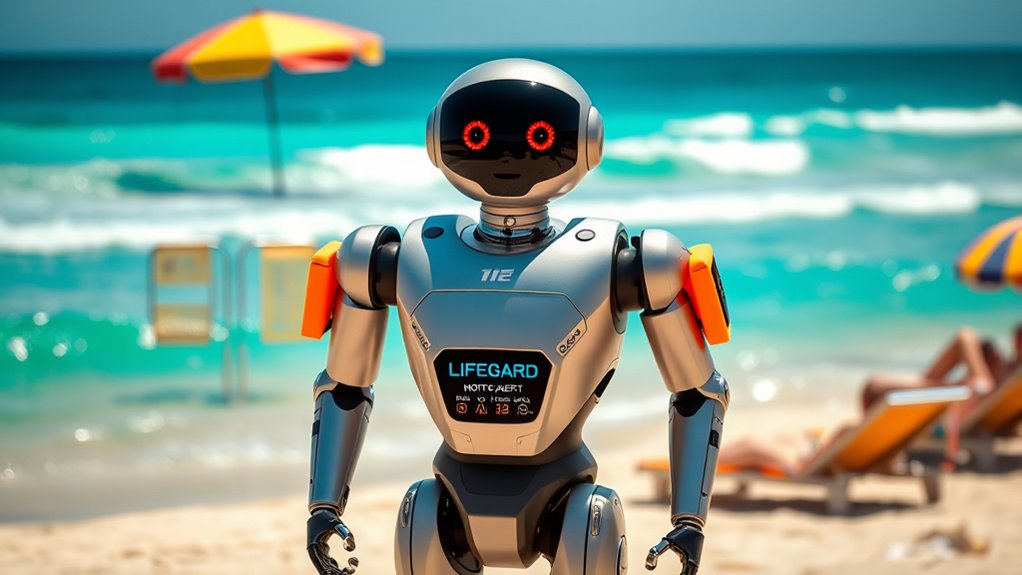

Lifeguard robots play a crucial role in public safety by providing constant surveillance and quick emergency responses in aquatic areas. They use advanced sensors and cameras to detect distressed swimmers faster than humans and can deploy flotation aids or alert lifeguards immediately. These robots work alongside traditional lifeguards, enhancing overall safety while operating around the clock, even during busy or dangerous hours. To discover how these innovations are transforming water safety, keep exploring the many ways they help protect lives.

Get pool and patio gear delivered free with Prime
- Fast, free delivery on millions of items
- Prime Video, Amazon Music and more included
- Member-only deals all year
Key Takeaways
- Lifeguard robots provide continuous, fatigue-free surveillance to enhance public safety at aquatic facilities.
- Equipped with advanced sensors, they detect distress signals faster than human lifeguards.
- They can respond quickly by deploying flotation aids or alerting emergency services.
- Robots complement traditional lifeguards, improving overall safety management and incident prevention.
- Increasing affordability and technology advancements expand their role in safeguarding water environments.

Have you ever wondered how technology is transforming public safety at beaches and pools? One of the most exciting developments is the use of lifeguard robots, which are changing how we approach drowning prevention. These machines leverage advanced robot technology to monitor large crowds, detect distressed swimmers, and respond quickly to emergencies. Unlike traditional lifeguards who rely solely on their eyesight and quick reflexes, robots can provide continuous surveillance without fatigue, guaranteeing that no swimmer goes unnoticed. This constant vigilance substantially increases safety and reduces the chance of accidents going unnoticed until it’s too late.
Lifeguard robots provide continuous, fatigue-free surveillance, greatly enhancing safety and drowning prevention at beaches and pools.
Lifeguard robots are designed with sophisticated sensors and cameras that allow them to scan extensive areas in real time. They can identify signs of trouble, such as a swimmer struggling or showing signs of distress, often faster than a human could. Once a potential emergency is detected, many of these robots are equipped to alert human lifeguards immediately or even intervene directly. Some models are outfitted with water rescue devices or can deploy flotation aids, making quick, effective responses possible even before human rescuers arrive. This rapid reaction capability is vital for drowning prevention, especially in crowded or expansive areas where human oversight might be limited.
The integration of robot technology into public safety systems isn’t about replacing lifeguards but enhancing their effectiveness. Robots serve as an extra set of eyes, tirelessly monitoring areas and providing early warnings that help save lives. Their ability to operate around the clock means safety isn’t compromised during night hours or busy weekends when crowds are largest. Additionally, these robots are programmed with safety protocols and can communicate with emergency services, providing detailed reports that help coordinate rescue efforts more efficiently. Furthermore, ongoing advancements in robot reliability ensure these devices can operate safely in challenging aquatic environments, increasing their utility and trustworthiness.
Beyond immediate rescue actions, lifeguard robots contribute to overall safety management. They can analyze patterns, detect high-risk zones, and help authorities develop better safety strategies. This proactive approach minimizes incidents and ensures resources are allocated where they’re needed most. As robot technology advances, these devices are becoming more affordable and easier to deploy, making them accessible to a wider range of beaches and pools. Their presence reassures the public that safety is a top priority, and that innovative solutions are actively working to prevent tragedies.
In short, lifeguard robots are transforming drowning prevention efforts, making public spaces safer for everyone. Their ability to monitor continuously, detect emergencies swiftly, and assist in rescues highlights how modern technology is redefining what safety looks like in aquatic environments. By embracing these innovations, communities can better protect lives and reduce the devastating impact of water-related accidents.
lifeguard robot with flotation device
As an affiliate, we earn on qualifying purchases.
As an affiliate, we earn on qualifying purchases.
Frequently Asked Questions
How Do Lifeguard Robots Handle Emergencies Involving Multiple Victims?
Lifeguard robots handle emergencies with multiple victims through multi-victim coordination and emergency prioritization. They quickly evaluate the situation, identify the most critical cases, and allocate resources accordingly. You’ll see the robots providing immediate assistance to the most severely injured, while alerting human responders for secondary victims. Their real-time decision-making ensures swift, efficient rescue efforts, minimizing risks and maximizing safety for everyone involved.
What Are the Maintenance Requirements for Lifeguard Robots?
You need to regularly check the battery life of your lifeguard robot to guarantee it stays operational during emergencies. Keep the software updated to improve performance, fix bugs, and add new features. Routine maintenance includes inspecting sensors, cleaning components, and testing mobility. Scheduling these tasks weekly or monthly helps prevent unexpected failures. Proper maintenance ensures your robot remains reliable, ready to respond quickly when needed, enhancing overall public safety.
How Do Robots Differentiate Between Swimmers and Non-Swimmers?
Imagine a vigilant guardian, eyes sharp and senses keen, guiding you safely. You’ll find that robots use advanced sensors for swimmer detection, distinguishing humans from non-swimmers. They analyze movement patterns, body shapes, and heat signatures to tell apart swimmers from obstacles or floaties. With obstacle avoidance technology, they navigate smoothly around swimmers, ensuring safety without causing disruptions. This intelligent detection creates a seamless, protective environment for everyone in the water.
Are There Ethical Concerns Regarding Robot Surveillance at Beaches?
Yes, there are ethical concerns about robot surveillance at beaches. You might worry about privacy concerns, especially if robots collect or monitor personal data without clear consent. These devices could intrude on your privacy or make you uncomfortable if you’re unaware of when you’re being watched. Addressing consent issues is vital to guarantee that people feel safe and respected, balancing safety benefits with individual rights.
How Do Lifeguard Robots Communicate With Human Emergency Responders?
Imagine witnessing a rescue unfold as lifeguard robots instantly alert emergency responders. You see the robot’s communication system, seamlessly transmitting real-time data and video feeds, ensuring emergency coordination is swift and precise. It uses secure, direct signals to connect with human responders, transmitting critical information instantly. This instant, reliable robot communication not only enhances safety but also makes you feel more secure, knowing technology is actively working to save lives right before your eyes.
aquatic surveillance robot for pools
As an affiliate, we earn on qualifying purchases.
As an affiliate, we earn on qualifying purchases.
Conclusion
So, next time you’re splashing around, remember that lifeguard robots are here to save the day—because nothing says “trust me” like a machine with a built-in camera and a laser glare. Who needs human judgment when you’ve got flashing lights and algorithms? Just don’t forget to thank your robotic saviors when they eject you from the pool for “unsafe behavior.” After all, in the future, safety’s just a code update away.
As an affiliate, we earn on qualifying purchases.
As an affiliate, we earn on qualifying purchases.
Columbus Day / Indigenous Peoples' Day Picks
long weekend sales
As an affiliate, we earn on qualifying purchases.