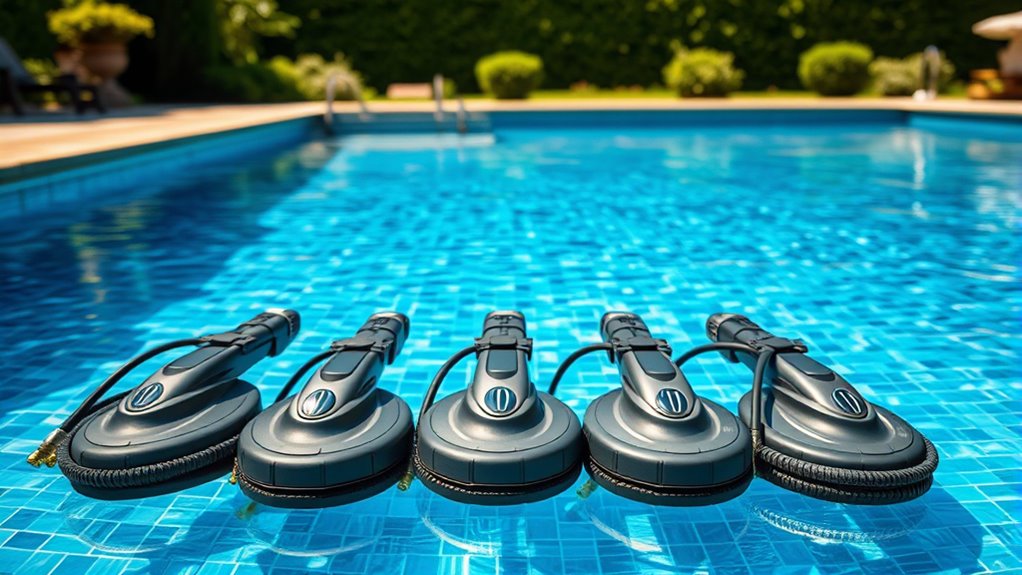

If you own an inground pool and you’re tired of hand-skimming leaves off the floor every weekend, a pressure side cleaner is the upgrade that does the dirty work for you. These cleaners tap into your pool’s return line, use jet-driven vacuum power to sweep the floor and walls, and collect debris in their own onboard bag — which keeps leaves and acorns out of your pump basket and filter, extending the life of your entire filtration system. In this comparison, two models stand out for very different reasons: the Polaris Vac-Sweep 280, my pick for best overall thanks to its dedicated-booster-pump power and large-debris handling, and the Intex ZX300, a budget-friendly entry point for smaller setups. The main tradeoff you’re weighing here is raw cleaning muscle versus total cost of ownership — the Polaris needs a booster pump and a dedicated return line to hit its three-hour cycle, while the Intex runs off an existing pump’s flow but isn’t engineered for full-size inground pools. My job in this guide is to make that decision easy for you.

Get pool and patio gear delivered free — and shop member deals
- Fast, free delivery on millions of items
- Access to Prime Big Deal Days deals on October 6–7
- Prime Video, Amazon Music and more included
Complete the kit


Key Takeaways
- The Polaris Vac-Sweep 280 is the true inground workhorse here — it cleans floors and walls in 3 hours or less using a dedicated booster pump and dual venturi jets.
- A pressure side cleaner’s biggest advantage is debris capture in an onboard bag, which keeps leaves and pebbles out of your pump basket and filter.
- The Polaris 280 requires a separate booster pump and a dedicated return line — confirm your pool has both before buying.
- The Intex ZX300 is the value option, but it’s designed for above-ground pools up to 26 feet round or 36 ft x 12 ft rectangular, so it only makes sense for compact or hybrid inground-style setups.
- The 280’s 2.25-inch inlet swallows acorns and pebbles that would clog a suction-side or robotic cleaner.
| Polaris Vac-Sweep 280 Pressure-Side In-ground Pool Cleaner |  | Best Overall | Cleaner type: Pressure-side, booster-pump powered | Pool compatibility: All inground pool shapes and surfaces | Cleaning cycle: 3 hours or less | VIEW ON AMAZON | See Our Full Breakdown |
| INTEX ZX300 Deluxe Pressure-Side Automatic Pool Vacuum Cleaner |  | Best Value | Cleaner type: Pressure-side, hydraulic powered | Pump flow required: 1,600–3,500 gallons per hour | Suction generated: Approximately 700 gallons per hour | VIEW ON AMAZON | See Our Full Breakdown |
| pressure side cleaner for inground pool | Cleaner type | Hose length | Unit weight | Special features |
|---|---|---|---|---|
| Polaris Vac-Sweep 280 Pressure | Pressure-side, booster-pump powered | 31 feet of feed hose | 6.2 pounds | Dual venturi jets, in-line back-up valve |
| INTEX ZX300 Deluxe Pressure-Si | Pressure-side, hydraulic powered | 21 feet, tangle-free | 14.9 pounds | Dual dirt scrubbers, all-wheel drive, wall climbing |
More Details on Our Top Picks
Polaris Vac-Sweep 280 Pressure-Side In-ground Pool Cleaner
The Polaris Vac-Sweep 280 is the model I’d point most inground pool owners toward, and the reasons come down to power and debris handling. Its dual venturi jets, driven by a separate Polaris booster pump, generate vacuum strength that sweeps and scrubs both the floor and the walls of your pool in three hours or less. That cycle time matters: it means you can run the 280 while you’re at work and come home to a clean pool, rather than running a slower cleaner all day.
Where the 280 separates itself from the Intex ZX300 is debris capacity. The 2.25-inch inlet and single-chamber filter bag are built to swallow acorns, pebbles, leaf clusters, and other bulky debris that would stall a smaller cleaner. If your pool sits under trees, this is the difference between a cleaner that works and one that constantly needs rescuing. The onboard bag also means your skimmer and pump basket stay clear, which reduces strain on your filtration system over time.
The in-line back-up valve is another advantage — if the 280 gets cornered in a step area or against a ladder, it automatically reverses and frees itself without your intervention. Compared with the ZX300, which relies on hose reach and pump flow from an existing system, the 280’s dedicated-booster design gives it more consistent traction and climbing on gunite, pebble, tile, vinyl, and fiberglass surfaces alike.
The tradeoffs are real, though. You need a dedicated return line and a booster pump, which adds cost if your pool wasn’t plumbed for it. At 6.2 pounds with a 31-foot feed hose, installation is straightforward for a pro but can frustrate a first-timer, and the listing notes professional installation as the intended path. If your pool lacks the dedicated plumbing, this isn’t the cleaner for you no matter how good it is.
Pros:- Cleans floor and walls in 3 hours or less with dual venturi jet power
- 2.25-inch inlet and large filter bag capture acorns, pebbles, and heavy leaf debris
- In-line back-up valve automatically frees the unit when cornered
- Safe for all inground surfaces including vinyl, fiberglass, gunite, pebble, and tile
Cons:- Requires a separate Polaris booster pump and a dedicated return line
- Professional installation is recommended, adding to setup cost
- Filter bag needs regular emptying during heavy debris seasons
Best for: Owners of full-size inground pools with a dedicated return line and booster pump, especially pools that collect heavy leaf and acorn debris
Not ideal for: Anyone whose pool lacks booster-pump plumbing, or buyers on a strict budget who can’t absorb the cost of a separate pump
- Cleaner type:Pressure-side, booster-pump powered
- Pool compatibility:All inground pool shapes and surfaces
- Cleaning cycle:3 hours or less
- Inlet size:2.25 inches
- Hose length:31 feet of feed hose
- Debris capture:Single-chamber all-purpose filter bag
- Unit weight:6.2 pounds
- Special features:Dual venturi jets, in-line back-up valve
Our verdict“If your inground pool has the plumbing for it, the Polaris 280 is the strongest, fastest, and most debris-tolerant pressure side cleaner you can buy in this comparison.”
INTEX ZX300 Deluxe Pressure-Side Automatic Pool Vacuum Cleaner
The Intex ZX300 plays a completely different role in this lineup: it’s the accessible entry point for owners who want automatic pressure-side cleaning without investing in a booster pump. Instead of a dedicated pump, the ZX300 generates roughly 700 gallons-per-hour of suction within the cleaner itself, drawing power from your existing pool pump as long as it flows between 1,600 and 3,500 gallons per hour. That self-sufficiency is its single biggest selling point compared with the Polaris 280 — no booster pump purchase, no dedicated return line, no professional install.
Its cleaning approach also differs from the Polaris in a useful way. The ZX300 uses dual dirt scrubbers that work the floor up to the waterline, and its water-powered all-wheel drive gives it genuine wall-climbing performance, which is impressive for a cleaner at this level. The 21-foot tangle-free hose keeps setup simple, and at 14.9 pounds the unit feels sturdier in hand than most budget cleaners.
Now, the honest caveat: Intex designed this cleaner for above-ground pools up to 26 feet round or 36 ft x 12 ft rectangular, and I want to be upfront that it isn’t engineered for full-size inground pools the way the Polaris 280 is. Where it earns a spot in an inground-focused roundup is for owners of small or compact inground and semi-inground pools whose pump output falls in that compatible flow range, and who want a low-cost way to automate floor cleaning. The 1.8-liter debris capacity is modest next to the Polaris bag, so heavy leaf-load pools will outpace it quickly.
Think of the ZX300 as a stepping stone: it delivers genuine automatic scrubbing for a fraction of the infrastructure the Polaris demands, but it trades away raw vacuum power, debris capacity, and cycle speed to get there.
Pros:- No booster pump or dedicated plumbing required — connects to the existing pool inlet
- Dual dirt scrubbers clean fine debris up to the waterline
- Water-powered all-wheel drive provides wall-climbing performance
- Tangle-free 21-foot hose and simple manual setup
Cons:- Designed around above-ground pool dimensions, not full-size inground pools
- 1.8-liter debris capacity fills quickly under heavy leaf load
- Dependent on pump flow rate staying within the 1,600–3,500 GPH range
Best for: Owners of small or compact inground-style pools with a compatible pump (1,600–3,500 GPH) who want automatic cleaning without a booster pump
Not ideal for: Full-size or heavily treed inground pools, or pools whose pump flow falls outside the compatible range
- Cleaner type:Pressure-side, hydraulic powered
- Pump flow required:1,600–3,500 gallons per hour
- Suction generated:Approximately 700 gallons per hour
- Debris capacity:1.8 liters
- Hose length:21 feet, tangle-free
- Unit weight:14.9 pounds
- Special features:Dual dirt scrubbers, all-wheel drive, wall climbing
Our verdict“The ZX300 is the smart low-infrastructure pick for small pools and compatible pumps, but it can’t match the Polaris 280’s power or capacity on a full-size inground pool.”
How We Picked
When I put this comparison together, I focused on the criteria that actually decide whether a pressure side cleaner works in a real backyard — not spec-sheet trivia. First, I looked at compatibility with inground pool plumbing, because a pressure cleaner is only as good as its connection to a dedicated return line or booster pump. Second, I judged debris capacity and inlet size, since the whole point of this cleaner type is capturing leaves, acorns, and pebbles before they hit your filter. Third, I weighed cleaning speed and coverage, including wall-climbing ability and whether the unit can free itself when it gets stuck in a corner. Finally, I factored in total cost of ownership — hose length, filter bag replacement, and whether a booster pump is required — because the sticker price is only part of the equation. The Polaris 280 earned the top spot on cleaning power and inground pedigree; the Intex ZX300 earned its place as the value alternative for owners with smaller pools and compatible pump flow rates.
| pressure side cleaner for inground pool | Cleaner type | Special features |
|---|---|---|
| Polaris Vac-Sweep 280 Pressure | Pressure-side, booster-pump powered | Dual venturi jets, in-line back-up valve |
| INTEX ZX300 Deluxe Pressure-Si | Pressure-side, hydraulic powered | Dual dirt scrubbers, all-wheel drive, wall climbing |
Factors to Consider When Choosing Pressure Side Cleaner For Inground Pools
Before you buy a pressure side cleaner for an inground pool, a handful of plumbing and performance factors decide which model will actually work in your backyard. Here’s what I tell buyers to check first.Do You Have a Dedicated Return Line and Booster Pump?
This is the single biggest question. Traditional pressure-side cleaners like the Polaris 280 are built to connect to a dedicated return line powered by a separate booster pump. If your pool was plumbed for this, you get maximum cleaning power and speed. If it wasn’t, you either pay for installation or choose a cleaner like the Intex ZX300, which runs off your existing pump’s flow. Matching the cleaner to your plumbing saves you from a costly return.
How Much Debris Does Your Pool Collect?
Debris load should drive your choice more than anything else. Pools near trees collect leaves, acorns, and seed pods that clog smaller inlets and fill small debris chambers fast. A large-inlet cleaner with a big filter bag — the Polaris 280’s 2.25-inch inlet and single-chamber bag — handles that load without stalling. A 1.8-liter capacity cleaner like the ZX300 suits lighter, finer debris and smaller footprints.
Cleaning Speed and Coverage
Cycle time determines how you use the cleaner. A three-hour cycle lets you run a quick clean before a pool party, while slower cleaners need to run for many hours or overnight. Also look at whether the cleaner climbs walls, scrubs to the waterline, and includes a back-up valve or self-righting feature so it doesn’t stall in corners and steps.
Surface Compatibility and Hose Reach
Confirm the cleaner is safe for your pool surface — vinyl, fiberglass, gunite, pebble, or tile — and that the included hose comfortably spans your pool’s longest dimension. The Polaris includes 31 feet of feed hose; the Intex includes a 21-foot tangle-free hose. A hose that’s too short leaves dead zones the cleaner simply can’t reach.
Frequently Asked Questions
What’s the difference between a pressure side cleaner and a suction side cleaner?
A suction side cleaner attaches to your skimmer or suction line and relies on your filter pump’s suction to pull in dirt, sending debris through your pool’s filtration system. A pressure side cleaner connects to a return line and uses jets of pressurized water — often from a dedicated booster pump — to move around the pool while collecting debris in its own onboard bag. The practical difference for you is that pressure side cleaners keep leaves and heavy debris out of your pump basket and filter entirely, which reduces maintenance and prolongs the life of your filtration equipment. That’s why models like the Polaris 280 with its large 2.25-inch inlet are favored for pools with heavy leaf and acorn loads.
Does the Polaris Vac-Sweep 280 really need a booster pump?
Yes, it does. The 280’s dual venturi jets are engineered around the consistent, high pressure that a separate Polaris booster pump supplies through a dedicated return line. Without that pump, the cleaner won’t generate the vacuum power or traction needed to clean a full inground pool in its advertised three-hour cycle, and coverage will suffer. If your pool already has a dedicated pressure line with a booster pump installed, you’re set. If it doesn’t, you’ll need to factor the pump and plumbing into your budget, or consider a cleaner like the Intex ZX300 that runs off an existing pump’s flow instead.
Can the Intex ZX300 be used in an inground pool?
Honestly, it’s a stretch for most inground pools. Intex designed and rated the ZX300 for above-ground pools up to 26 feet in diameter or 36 ft x 12 ft rectangular, and its suction is generated from your existing pump’s flow rather than a booster pump. That said, owners of small, compact, or semi-inground pools with soft-wall-style finishes and a pump in the 1,600 to 3,500 GPH range can get useful automatic floor cleaning from it at a much lower cost of entry. For a full-size gunite or pebble inground pool with heavy debris, the Polaris 280 is the better-matched tool.
How often do I need to empty the debris bag or chamber?
It depends entirely on your debris load and the cleaner’s capacity. During heavy leaf season, a large single-chamber bag like the Polaris 280’s may need emptying every few cleaning cycles, while lighter weeks can go longer between emptyings. The Intex ZX300’s 1.8-liter chamber is much smaller, so in a debris-heavy pool you’ll be emptying it far more frequently, which can erode the convenience of automatic cleaning. My advice is to check the bag or chamber after each cycle for the first few weeks until you learn your pool’s debris pattern, then settle into a routine.
Are pressure side cleaners safe for vinyl and fiberglass pools?
The Polaris Vac-Sweep 280 is explicitly rated as safe for all common inground surfaces, including vinyl, fiberglass, gunite, pebble, and tile, so yes — the right pressure side cleaner works on soft surfaces without damage. The key is checking the manufacturer’s surface ratings before buying, since wheel and jet designs vary between models. Because pressure side cleaners use water jets and wheeled drive rather than abrasive suction pads, they tend to be gentle on finishes while still scrubbing the floor and walls as they travel.
Conclusion
My recommendation comes down to your plumbing and your pool’s size. If you own a full-size inground pool with a dedicated return line and booster pump — or you’re willing to install them — the Polaris Vac-Sweep 280 is the clear choice: faster cycles, wall-to-floor scrubbing, and a debris bag that swallows acorns and leaves whole. Choose the Intex ZX300 if you have a small or compact pool with a compatible pump flow rate and you want automatic cleaning without the booster-pump investment. What you shouldn’t do is buy the Intex for a large, heavily treed inground pool and expect Polaris-level results — the capacity and power gap is simply too wide. Match the cleaner to your plumbing first, your debris load second, and you’ll end up with the right machine.
Fall Picks
fall essentials
As an affiliate, we earn on qualifying purchases.