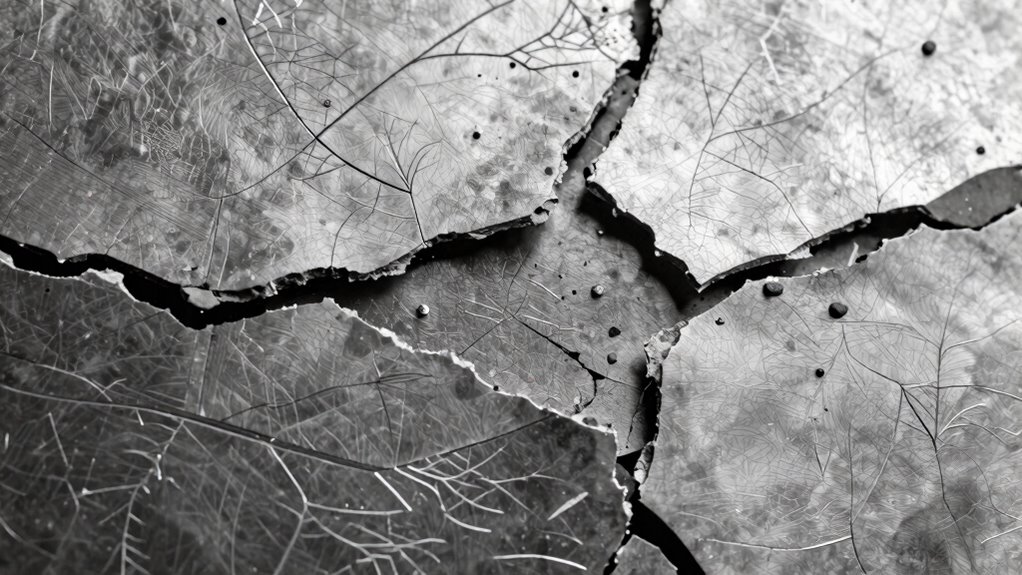

In material science, surface stress from manufacturing or environmental conditions causes cracks and spalling, especially when it exceeds the material’s capacity. Microstructural defects like dislocations and voids act as stress points, promoting crack growth and weakening the material. Etching reveals these defects and microstructure details, which can influence crack initiation and accelerate corrosion. By understanding these processes, you can better grasp how materials fail and how to improve their durability—continue exploring to uncover more details.

Get pool and patio gear delivered free with Prime
- Fast, free delivery on millions of items
- Prime Video, Amazon Music and more included
- Member-only deals all year
Key Takeaways
- Surface stress originates from atomic arrangement disparities, manufacturing, and environmental factors, leading to crack initiation when exceeding material capacity.
- Microstructural defects like dislocations and voids act as stress concentrators, promoting crack growth and failure.
- Etching reveals microstructure and defect distribution, highlighting stress concentration zones and potential crack initiation sites.
- Spalling occurs when internal stresses surpass fracture toughness, causing surface layers to flake or detach, often due to microstructural weaknesses.
- Controlling microstructure, reducing defects, and managing surface stress enhance material durability and resistance to cracking and spalling.
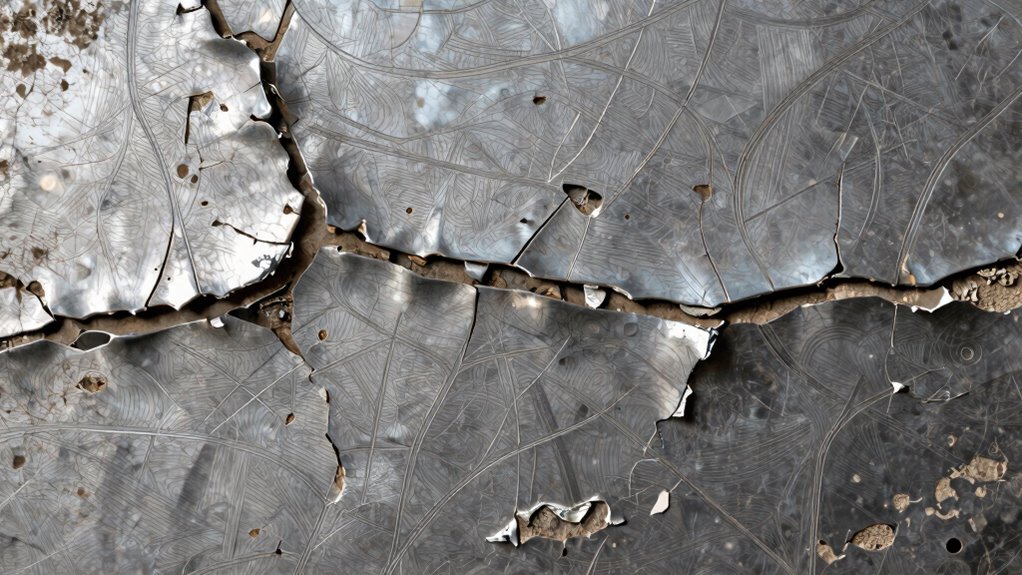
Understanding the material science behind cracking, etching, and spalling is essential for improving the durability and performance of various engineering components. At the core of these failure mechanisms lies surface stress, which you must recognize as a crucial factor influencing material integrity. Surface stress arises from uneven atomic arrangements at the material’s surface, often caused by manufacturing processes, environmental conditions, or operational loads. When surface stress exceeds the material’s ability to accommodate it, cracks can initiate and propagate, leading to eventual failure.
Microstructural defects play a significant role in this process. These defects—such as dislocations, voids, inclusions, or grain boundaries—act as stress concentrators. When you examine a material’s microstructure, you’ll find that these imperfections create localized zones where stress intensifies. Under cyclic loading or prolonged exposure to harsh environments, these concentrated stresses can cause microcracks to form and expand. Over time, these microcracks coalesce, resulting in visible cracks, etching pits, or spalling of material fragments.
Microstructural defects concentrate stress, promoting crack formation and material failure under cyclic loading and harsh conditions.
Etching often reveals the underlying microstructure and defects. You may notice that areas with higher defect densities etch more rapidly, exposing grain boundaries, phase interfaces, or dislocation networks. This process is not merely aesthetic; it signals the presence of microstructural vulnerabilities. When etching occurs unevenly, it can accentuate stress concentrations, further promoting crack initiation. In some cases, etching also facilitates corrosion processes, weakening the material at the microstructural level and accelerating failure.
Spalling, which involves the flaking or breaking away of surface layers, is closely linked to the internal stresses and defects within the material. When surface stress builds up beyond the material’s fracture toughness, and microstructural defects are present, it becomes easier for chunks of material to detach. Spalling can be triggered by thermal cycling, fatigue, or environmental degradation, all of which influence surface stress and defect behavior. Additionally, microstructural heterogeneity can significantly impact the likelihood of spalling by creating zones of weakness within the material. As material layers spall off, the underlying microstructure is exposed, often revealing damage that was initially hidden beneath the surface.
In essence, managing surface stress and reducing microstructural defects are crucial strategies in preventing cracking, etching, and spalling. By controlling manufacturing processes, heat treatments, and environmental exposure, you can minimize the formation of defects and surface stresses. Doing so enhances the material’s overall resilience, extending its service life and ensuring safer, more reliable performance of engineering components.
metal etching kit for microstructure analysis
As an affiliate, we earn on qualifying purchases.
As an affiliate, we earn on qualifying purchases.
Frequently Asked Questions
How Do Environmental Factors Influence Crack Propagation in Materials?
Environmental factors like environmental degradation and stress corrosion considerably influence crack propagation in materials. When exposed to moisture, chemicals, or extreme temperatures, your material becomes more vulnerable, accelerating crack growth. Stress corrosion, in particular, causes cracks to deepen under combined mechanical stress and corrosive environments. You should regularly assess environmental conditions and implement protective measures, such as coatings or corrosion inhibitors, to slow crack propagation and extend your material’s lifespan.
Can Material Properties Be Engineered to Prevent Spalling?
Yes, you can engineer material properties to prevent spalling by using advanced surface treatments and coating technologies. These methods enhance adhesion, improve toughness, and create a protective barrier against environmental stresses. By selecting suitable coatings and treatments, you strengthen the material’s resistance to cracking and delamination, effectively reducing spalling risks. Implementing these strategies helps you extend the lifespan and maintain the integrity of your materials in demanding conditions.
What Role Do Microstructures Play in Cracking and Etching Processes?
You might think microstructures are just tiny features, but they play a vital role in cracking and etching processes. Their influence on crack initiation determines how easily cracks form under stress or corrosion. A refined microstructure can distribute stresses more evenly, reducing crack initiation, while certain grain boundaries or phases may accelerate etching. Understanding this relationship helps you design materials that resist damage, ultimately improving durability and performance.
How Are Modern Imaging Techniques Used to Analyze Surface Spalling?
You use modern imaging techniques like scanning electron microscopy (SEM) to analyze surface spalling. These methods reveal detailed surface topography, showing how flakes detach or crack. High imaging resolution allows you to observe microstructural features that contribute to spalling, such as voids or stress concentrations. This detailed analysis helps you understand failure mechanisms, improving material design to prevent future spalling and extending component lifespan.
What Are Emerging Materials Resistant to Cracking and Spalling?
You should explore emerging materials designed to resist cracking and spalling through nanostructure optimization and advanced surface coating strategies. These innovations enhance material toughness and durability by reducing stress concentrations and providing protective barriers. Such materials often feature nanostructured surfaces or coatings that improve adhesion, flexibility, and resistance to environmental factors. Staying updated on these developments can help you select or engineer materials with superior resilience in demanding applications.
crack detection and inspection tools
As an affiliate, we earn on qualifying purchases.
As an affiliate, we earn on qualifying purchases.
Conclusion
You now understand how cracks form, how etching reveals secrets beneath surfaces, and how spalling causes layers to break away. You see the delicate balance of stress and material properties at play, the intricate dance of forces, and the precision needed to control or prevent damage. With this knowledge, you can better predict, manipulate, and innovate in material science—cracking, etching, and spalling no longer mysteries but tools in your hands for discovery and development.
microstructural defect visualization microscope
As an affiliate, we earn on qualifying purchases.
As an affiliate, we earn on qualifying purchases.
surface stress measurement device
As an affiliate, we earn on qualifying purchases.
As an affiliate, we earn on qualifying purchases.
Fall Picks
fall essentials
As an affiliate, we earn on qualifying purchases.