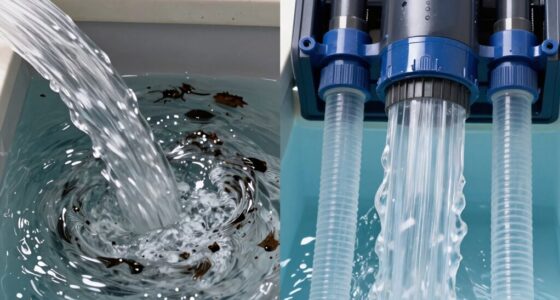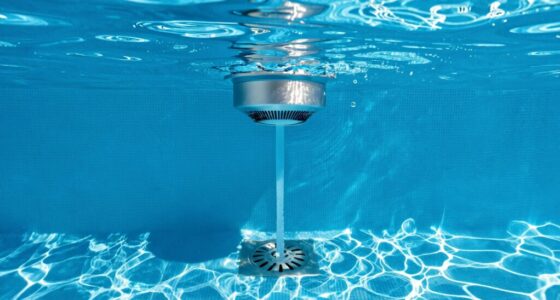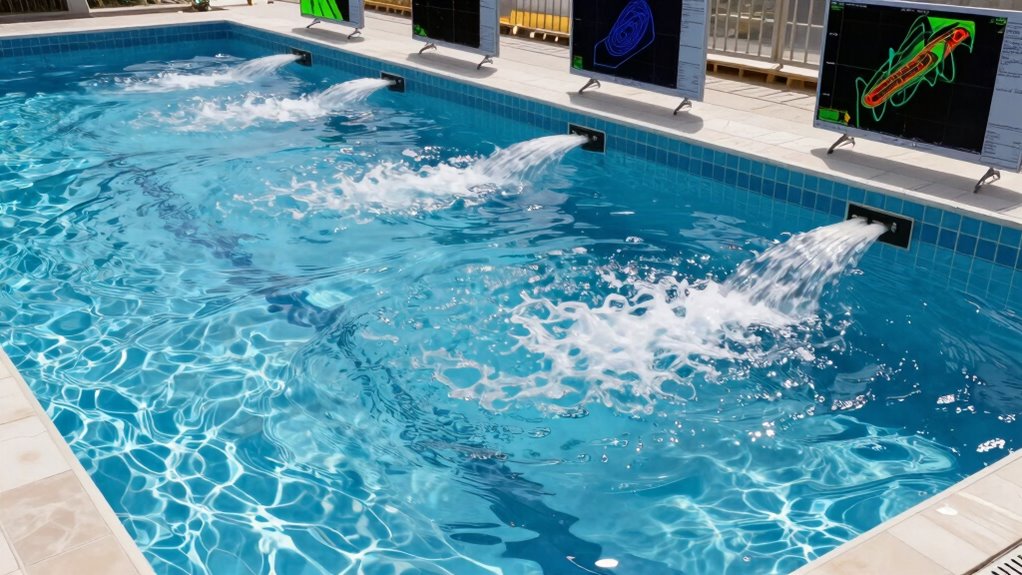

CFD and modeling tools help you make smarter pool design choices by accurately predicting water flow, circulation, and temperature distribution. You can visualize different shapes, features, and lighting effects before construction, ensuring aesthetic appeal and functionality. These techniques allow you to test various pump setups and optimize energy efficiency, saving costs in the long run. By understanding environmental factors and seasonal changes, you’ll create more sustainable pools. Continue exploring to discover how these methods can transform your pool planning process.

Get pool and patio gear delivered free with Prime
- Fast, free delivery on millions of items
- Prime Video, Amazon Music and more included
- Member-only deals all year
Key Takeaways
- CFD predicts water flow and temperature distribution, optimizing circulation and reducing dead zones for cleaner, more efficient pools.
- Modeling enables visualization of aesthetic features and lighting effects, ensuring visual harmony without compromising water performance.
- Simulations test different pump settings and layouts, enhancing design efficiency and reducing trial-and-error during construction.
- Advanced techniques incorporate complex water behaviors, promoting sustainable, energy-efficient, and environmentally responsible pool systems.
- Seasonal and climate simulations help design adaptable pools that maintain performance and attractiveness year-round.
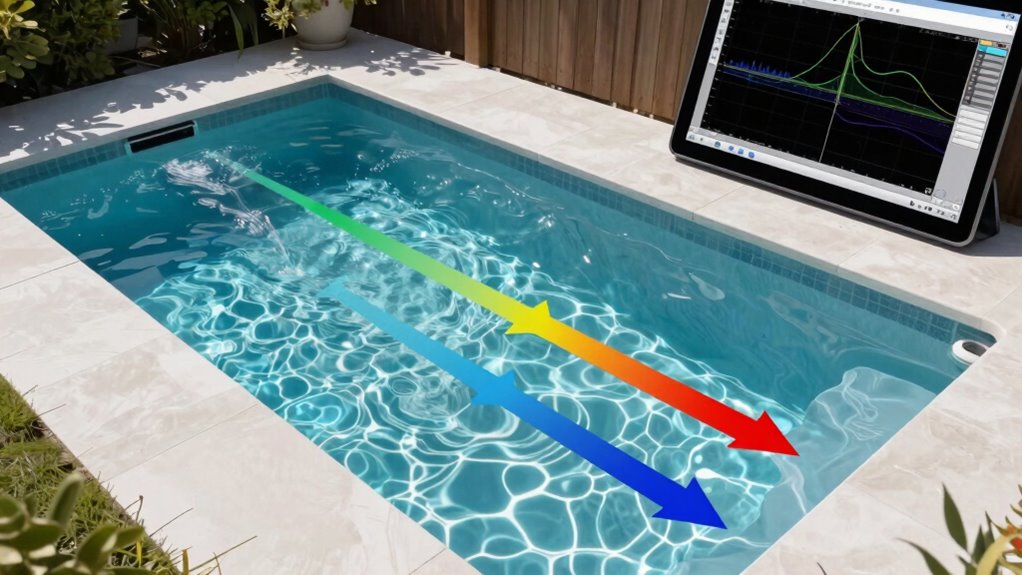
Computational Fluid Dynamics (CFD) and modeling have become essential tools in modern pool design, allowing you to predict water flow, circulation patterns, and temperature distribution with remarkable accuracy. These techniques give you the ability to enhance various aspects of your pool, guaranteeing it functions efficiently and looks exactly how you envision. When focusing on hydrodynamic efficiency, CFD helps you identify the most effective placement and design of jets, skimmers, and return outlets. By simulating water movement, you can minimize stagnation zones, reduce energy consumption, and improve overall circulation. This means your pool stays cleaner longer, heats more evenly, and uses less power, saving you money in the long run.
CFD optimizes pool flow, reducing energy use and preventing stagnation for a cleaner, more efficient swimming experience.
Beyond performance, CFD and modeling empower you to explore aesthetic customization without guesswork. You can visualize how different shapes, features, and lighting will look and behave before construction begins. Want a waterfall or a unique bench design? Modeling allows you to see how these elements influence water flow and visual appeal, helping you fine-tune details to match your style. This proactive approach guarantees your pool isn’t just functional but also complements your landscape and personal taste, creating a space that feels tailored to you.
Using CFD, you can also test various scenarios, such as different pump speeds or circulation layouts, to find the most effective setup. This iterative process provides valuable insights into how subtle changes impact both hydrodynamic efficiency and aesthetic harmony. For example, adjusting a jet’s angle or position can greatly improve water movement, reducing dead zones and enhancing visual effects like ripples or reflections. This level of precision means you won’t have to rely on trial-and-error during construction, saving time and avoiding costly modifications later. Additionally, accurate flow simulations enable designers to optimize pool features for energy efficiency and sustainability from the outset. Incorporating advanced modeling techniques allows for a deeper understanding of complex water behaviors, leading to more innovative and efficient design solutions. Moreover, understanding fluid behavior helps in creating pools that are not only visually appealing but also environmentally responsible, especially when combined with sustainable materials and practices.
Furthermore, modeling tools can simulate seasonal changes and weather conditions, ensuring your pool remains functional and attractive year-round. These simulations can also aid in planning for climate variability, helping to adapt pool systems for different weather patterns. Moreover, CFD modeling supports sustainable design practices. By accurately predicting temperature distribution and flow patterns, you can design pools that heat efficiently and operate with minimal energy. This not only lowers your operational costs but also reduces your environmental footprint.
In essence, CFD and modeling elevate your pool design process from a series of guesses to a precise science. They help you balance hydrodynamic efficiency with aesthetic customization, ensuring your pool is as functional as it is beautiful. By leveraging these advanced tools, you gain confidence that every aspect of your pool—performance, style, and sustainability—is perfected, making your dream pool a reality that exceeds expectations.
Products Worth Considering

TCL 85-Inch QM64L QD-Mini LED 4K Smart Fire TV

Philips Hue Play Floor Lamp, RGBWWIC LED, 53 Inch, Black

Philips Hue Bridge Pro Smart Lighting Hub, 1-Pack
As an affiliate, we earn on qualifying purchases.
Frequently Asked Questions
How Much Does CFD Analysis Typically Cost for Pool Projects?
CFD analysis for pool projects usually costs between $2,000 and $10,000, depending on the complexity and scope. You should consider your budget and use cost estimation to determine if the investment is worthwhile. More detailed models with advanced simulations tend to be pricier, but they can save you money long-term by optimizing design and preventing costly errors. Always get quotes from multiple providers to compare costs effectively.
What Software Tools Are Most Commonly Used for CFD in Pool Design?
You’ll most likely use software like ANSYS Fluent, Autodesk CFD, or OpenFOAM for CFD in pool design. These tools help you analyze flow dynamics and optimize energy efficiency. With them, you can visualize water movement, identify turbulence, and improve circulation. This leads to more efficient pool systems, better water quality, and energy savings. By choosing the right software, you enhance both performance and comfort for swimmers.
How Long Does a CFD Modeling Process Usually Take?
A CFD modeling process typically takes anywhere from a few days to a couple of weeks, depending on the complexity of your pool design and the level of detail needed for hydrodynamic simulations. During this time, you’ll analyze water flow, energy efficiency, and circulation patterns. This thorough process helps identify areas for improvement, ensuring your pool is both efficient and comfortable, ultimately saving you time and resources in the long run.
Can CFD Predict Long-Term Pool Wear and Tear?
Yes, CFD can predict long-term pool wear and tear by simulating material durability and identifying stress points over time. You can use these models for maintenance forecasting, helping you plan repairs before issues arise. While CFD offers valuable insights, it’s crucial to integrate it with real-world data for the most accurate predictions. This proactive approach ensures your pool remains in top condition longer, saving you money and effort.
Is Specialized Training Required to Interpret CFD Results Accurately?
Expert interpretation of CFD results does require specialized training, so you’re better equipped to understand complex flow patterns and identify potential issues accurately. While some foundational knowledge might be gained through online courses or tutorials, thorough training ensures you grasp the nuances and avoid misinterpretation. Investing in this training helps you make confident, data-driven pool design decisions, ultimately improving efficiency, safety, and longevity of your pool projects.
Conclusion
As you harness the power of CFD and modeling, you’re not just shaping pools—you’re shaping the future of aquatic design. Every simulation brings you closer to perfection, revealing secrets that could redefine comfort, efficiency, and safety. But remember, the true breakthrough lies ahead, waiting in the depths of innovation. Are you ready to dive deeper and uncover what’s possible? The next wave of discovery is just around the corner—if you’re willing to explore it.