TL;DR
Inflatable pool floats for adults range from compact loungers to oversized rafts, but “adult size” has no standard meaning. Check the actual dimensions and weight limit, choose a shape for how you want to relax, and treat every float as a recreational product rather than safety equipment. For longer use, construction, inflation, storage, and water conditions matter as much as comfort.
A giant inflatable raft can look like a floating daybed in the product photo and feel like a crowded beach towel once you climb aboard. The label “adult size” has no standard measurement, so the name alone cannot tell you whether a float will suit your height, weight, or favorite way to relax.

Get pool and patio gear delivered free with Prime
- Fast, free delivery on millions of items
- Prime Video, Amazon Music and more included
- Member-only deals all year
This guide walks you through the most important aspects to check: fit, shape, comfort, materials, and where you plan to use the float. You’ll also get a practical way to compare loungers, tubes, and rafts, plus advice for inflation, upkeep, and safer use. Think of your float like a patio chair: the prettiest one isn’t necessarily the one you’ll want to sit in all afternoon.
One note before you shop: this blog research brief describes common features and buying checks, not a live ranking of products. Designs and specifications vary by brand, so read the current product instructions before you buy.
Compare a float’s actual length and width with your height and preferred position; “adult size” has no consistent measurement.
Treat the stated weight capacity as a limit, not a guarantee of comfort or stability.
Choose a lounger, tube, or raft for how you plan to recline, sit, or stretch out.
Read the construction and care details, and use a pump compatible with the valve.
Keep floats in suitable water conditions and never rely on one to prevent drowning.
Check the dimensions before trusting “adult size”
Inflatable pool floats for adults come in many sizes, and “adult” does not tell you how long or wide a model is. Compare the listed dimensions with your height and the position you plan to use, then check the maker’s stated weight limit. That combination gives you a more useful picture than a product label or a cheerful photo.
Imagine you’re 6 feet tall and want to lie flat with your head supported. A short lounger might technically hold your weight but leave your feet dangling. If you prefer to curl up with a book, that same length could be fine. A friend who wants to sit upright may care more about seat width and back support than total length.
Capacity is a limit, not a comfort guarantee. A raft rated for two people may feel cramped or unstable near its stated maximum, especially if people shift around. “Heavy-duty” and “adult” also aren’t consistent technical standards across brands, so compare actual specifications and warranty terms.
Dimensions describe the float’s outer footprint, not necessarily the space your body can use. Raised sides, a thick headrest, or a wide border can reduce the usable area, while a mesh center changes where your body rests. If you’re between sizes, consider whether extra room is worth the larger footprint: a bigger float may feel less restrictive but can crowd a small pool, catch more wind, and take longer to inflate and store.
Before ordering, check the dimensions, rated capacity, user reviews that describe real fit, and whether the float is meant for one person or several. If the listing leaves these details unclear, you have little basis for judging how the float will work in your pool.
Products Worth Considering

eufy C28 Robot Vacuum and Mop Combo with HydroJet Roller, 15,000 Pa Suction, and Self-Emptying Station

Bose Smart Ultra Dolby Atmos Soundbar with Voice Control, HDMI eARC, Black

Philips Hue Play HDMI Sync Box
As an affiliate, we earn on qualifying purchases.
Match the float shape to the way you relax
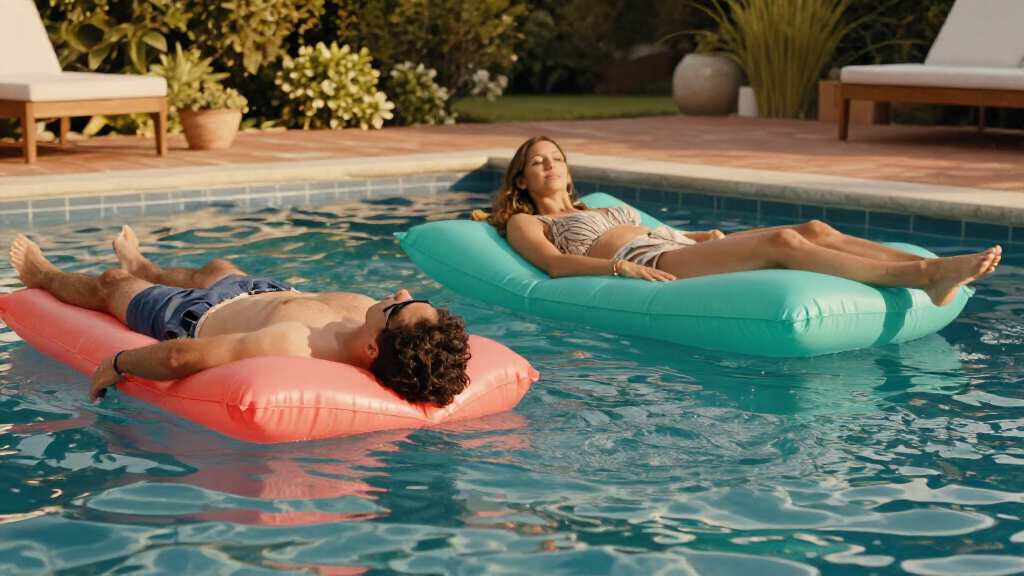
Choose a lounger for reclining, a tube for an open seated position, and a raft for a broader surface. Each shape supports a different kind of pool day, much like a reading chair, stool, and daybed suit different corners of a home. The right style depends on what you want your body to do, not just what looks fun in a shop photo.
A lounger with a mesh seat, headrest, and backrest may suit you if you want to stay partly in the water while reading. A tube keeps your legs more open and can work for a short, relaxed drift around a pool. A raft gives you more room to stretch out, though a wide surface may be harder to move or store.
Use this quick comparison to narrow your choice:
| Style | Works well for | Check before buying |
|---|---|---|
| Lounger | Reclining or reading | Back support and usable length |
| Tube | Open, seated floating | Seat position and fit |
| Raft | Spreading out or sharing | Capacity, width, and storage |
The shape also affects how easy it is to get on and stay positioned. A low, flat raft can offer room to stretch, but climbing aboard may be awkward and shifting your weight can tip or flex it. A tube is usually easier to settle into, though it offers less support for your back. A lounger’s backrest can make reading more comfortable, but it may limit how freely you can turn or lie down.
For example, a person who likes to cool their legs in the water might prefer a mesh-bottom lounger to a fully enclosed raft. Someone sharing a small pool may favor a compact tube so it doesn’t take over the water. Choose for your usual routine; novelty shapes are entertaining, but they can be awkward to climb onto or fold away.
Spend on support you’ll feel after ten minutes
Comfort depends on the shape and support points that match your position. Headrests help when you recline, while a backrest and armrests can make sitting more comfortable. Mesh seats let water reach your body and can feel cooler on a hot afternoon, though they may not suit you if you want to stay dry.
Picture a sunny Saturday: you settle onto a float with a cold drink, only to find that the smooth plastic slides under you every time you reach for it. A textured seat or more supportive back can make a bigger difference than a cup holder. Some adult floats range from compact loungers to oversized rafts with built-in coolers, but extra features also add bulk and can take up valuable pool space.
Comfort features affect how you use the float, not just how it feels at first. A firm backrest can support a reading position, but if its angle doesn’t suit your height, you may end up bracing yourself or sliding down. A mesh seat can keep you cooler, while a solid surface can feel warmer and keep more of your body dry. Neither is universally better; consider whether you tend to move, recline, or sit in one position for long stretches.
Use the list below to choose features for a real use case, such as a quiet hour with a book or a social afternoon with friends.
- For reading: Look for a stable backrest and a headrest that fits your height.
- For cooling off: Consider a mesh seat that keeps part of your body in the water.
- For sitting upright: Check armrests and whether the seat position keeps you comfortable.
- For sharing: Check the capacity and width, and think about how people will shift their weight.
- For drinks: Treat cup holders as a convenience, not a reason to overlook fit and construction.
When you compare products, ask yourself how you’ll spend the first half hour on the float. If you usually lean on one arm or move around often, a flat, narrow raft may frustrate you. The best extras solve a problem you actually have.
Look beyond the word “heavy-duty”
Materials and construction affect how a float holds up, but marketing labels don’t provide a common standard. Many floats use PVC or similar vinyl. Check for details about seam construction, the number of air chambers, repair support, and the manufacturer’s warranty. Reviews may add context, especially when they describe repeated use instead of a single afternoon.
A multi-chamber float has some redundancy: if one chamber loses air, another may still hold air. That can be useful, but it does not make the float fail-safe or turn it into safety equipment. Reinforced seams and thicker material may suit frequent use, though the float can still be punctured by a rough pool edge, gravel, or a sharp toy.
Construction details matter because they influence both durability and what happens when damage occurs. More chambers can help preserve some buoyancy after one chamber leaks, but the float may still become uneven or difficult to control. Thicker material may resist everyday scuffs, yet it can add weight and make a large raft less convenient to carry. Seam details, valve quality, and repair instructions help you judge likely upkeep, though none guarantees a particular lifespan.
For instance, if you take a float to a rental cottage every weekend, a repair kit and a warranty may matter more than a decorative print. If you only use it a few times each summer, compact storage and easy inflation may deserve more attention. Small punctures can sometimes be patched with a compatible kit, but repairs depend on the material and where the damage sits; a leak at a seam or valve may be difficult to fix reliably.
Compare specific claims, not adjectives. Check whether the maker describes the material, valve, chambers, and repair instructions. If those details are missing, don’t assume that “heavy-duty” guarantees a longer life.
Keep pool floats in the pool unless conditions suit them
A pool float is a recreational product, not a life-saving device. A float intended for calm pool water may not be suitable for a lake, river, or ocean. Wind, waves, currents, drains, and boat traffic can move even a large raft away from you faster than it appears from the shore.
That oversized surface can catch the wind like a sail. At a lakeside picnic, a person might drift a short distance while reaching for a drink; then a gust can carry the raft farther from shore. Keep floats close to shore, away from currents, drains, and boat lanes, and follow the product instructions about where it can be used.
Sun and heat matter, too. Air inside an inflatable expands as it warms, so follow the maker’s inflation guidance and avoid overinflating. If you inflate a float in a cool garage and leave it in direct midday sun, the pressure inside can change. Don’t leave it baking on hot concrete between swims.
Keep your attention on people in the water. A float cannot prevent drowning or replace swimming ability, close supervision, or a life jacket where one is required. Children need active adult supervision around pools and floats; never rely on an inflatable to keep a child safe.
Before using a float away from a pool, check its instructions and local conditions. If wind, waves, or currents are present, skip it or stay in a safer, supervised swimming area.
Inflate, clean, and store your float so it lasts
Follow the valve and care instructions for your exact model, and check whether a suitable pump comes in the box. A manual pump may work for a compact tube, while a large raft can take a lot of effort without an electric pump. Don’t assume every pump fits every valve, and don’t use an air compressor unless the maker says it’s compatible.
Think of care as a small reset after each swim. Chlorine and salt can leave residue on vinyl, while grit can scratch it during storage. Rinse the float, let it dry fully, then deflate and fold it as directed. A damp fold tucked into a dark garage can become a sticky, unpleasant surprise when summer returns.
Inflation and cleaning affect how well the float works over time. Too little air can let the surface sag and make seams flex more as you move; too much pressure, especially as the float heats in the sun, can strain seams and valves. Follow the maker’s guidance rather than aiming for maximum firmness. Rinsing removes pool chemicals or salt, and drying before storage helps prevent trapped moisture from making the material tacky or unpleasant.
Use this simple routine after a pool day:
- Check the float for damage before inflating, especially around seams and valves.
- Inflate as directed, leaving room for air to expand in the sun.
- Rinse off chlorine or salt after use.
- Dry it completely before deflating or folding it away.
- Store it out of direct sunlight, away from sharp objects, and follow the maker’s repair guidance if you find a leak.
If the float feels soft during a session, get out and inspect it rather than continuing to rely on it. For a small puncture, use a patch that matches the float material and follow its instructions. A leaking valve or seam may need more than a simple patch.
Frequently Asked Questions
What size pool float is best for an adult?
Compare the float’s actual length and width with your height and the position you prefer. Check its capacity too, but don’t use that number as your only measure of fit. A tall person who wants to lie flat may need more length than someone who plans to sit upright.
How much weight can an adult pool float hold?
Follow the manufacturer’s stated weight limit, which differs by model. A capacity is a limit, not a guarantee that the float will feel roomy or stable at that load. Going over it can increase the chance of damage or instability.
Are inflatable pool floats safe?
They can be enjoyable for recreation in suitable conditions, but a pool float is not a life-saving device. It cannot replace swimming ability, close attention in the water, or a life jacket where one is required. Supervise children closely around floats and pools.
Can I use a pool float at the beach or in a lake?
Check the float’s instructions and the water conditions first. Wind, waves, and currents can carry a float away, and pool-oriented designs may not suit open water. Stay close to shore and away from boat lanes, drains, and currents.
How do I choose between a lounger, tube, and raft?
A lounger suits reclining, a tube leaves a more open seated position, and a raft offers a broader surface. Think about comfort, capacity, pool space, and where you’ll store it. For example, a small pool may be more comfortable with a compact tube than an oversized raft.
How do I inflate and store a pool float?
Follow the valve instructions and confirm whether the float needs a compatible pump. Rinse away chlorine or salt, dry the float fully, then deflate and store it out of direct sunlight and away from sharp objects. Leave room for air to expand in heat, and avoid overinflating.
Conclusion
Choose your float by fit, intended use, and clear product details, then follow the maker’s instructions for inflation and care. A roomy raft may feel like a floating daybed in the right pool; the same raft can become awkward in wind or take over a small storage cupboard.
Before you buy, picture a real afternoon on it: where your head rests, how you get on, and where it goes when the swim ends. Then you can spend less time wrestling vinyl and more time listening to the water lap at the pool edge.