
Oxidation-Reduction Potential (ORP) measures how likely a solution is to gain or lose electrons during chemical reactions. It indicates whether the environment is oxidizing (high ORP) or reducing (low ORP). ORP is affected by factors like pH, temperature, and ions present. By understanding ORP, you can better control processes like water treatment or food safety. Keep exploring to discover how ORP impacts various systems and why it’s essential.
Key Takeaways
- ORP measures a solution’s tendency to gain or lose electrons, indicating its oxidizing or reducing capacity.
- It is determined by comparing the voltage between a reference electrode and the solution.
- High ORP values reflect strong oxidizing conditions; low or negative values indicate reducing environments.
- ORP is used to monitor water quality, disinfection, and chemical reaction efficiency.
- Factors like pH, temperature, and ions influence ORP readings and their interpretation.

Have you ever wondered how scientists measure the tendency of a solution to gain or lose electrons? That’s where oxidation-reduction potential, or ORP, comes into play. ORP is a way to quantify how likely a solution is to undergo electron transfer, which is central to many chemical processes. When you think about redox reactions, you’re looking at two key players: the oxidant, which accepts electrons, and the reductant, which donates them. These reactions involve the transfer of electrons, and ORP provides a numerical value indicating how readily this transfer occurs within a solution.
In simple terms, ORP measures the potential difference between a solution and a reference electrode. This potential difference reflects the balance between oxidizing and reducing agents present. If the solution has a high ORP value, it indicates a strong tendency to accept electrons, meaning it’s an oxidizing environment. Conversely, a low or negative ORP suggests the solution tends to donate electrons, making it more reducing. This measurement is crucial in various fields, from water treatment to food safety, because it helps you assess the chemical state of a solution quickly and accurately.
Understanding how electron transfer influences ORP can clarify how different substances behave in a solution. For example, when you add chlorine to water, the chlorine molecules act as oxidants, accepting electrons from contaminants and disinfecting the water. The ORP reading will rise, signaling a more oxidizing environment. On the other hand, in a reducing environment—say, with the presence of certain organic materials—the ORP value drops, indicating a greater potential for the solution to donate electrons. This dynamic makes ORP a valuable tool for monitoring and controlling chemical processes, ensuring safety and efficiency.
It’s important to remember that ORP doesn’t specify which substances are present but rather indicates the overall electron transfer capacity of the solution. When you interpret ORP, you’re essentially gauging the balance of redox reactions happening at that moment. Factors like pH, temperature, and the presence of specific ions can influence the measurement, so understanding these variables helps you make more accurate assessments. Whether you’re managing a swimming pool, treating wastewater, or analyzing biological systems, ORP provides a straightforward way to gauge the redox state and predict how the solution will behave during chemical reactions involving electron transfer. Additionally, knowledge of tableware materials can be relevant in environments where corrosion or oxidation processes affect metal items.

ORP Meter, ORP Redox Meter Tester -1999~1999mV, 1-Point Calibration, Oxidation Reduction Potential, Aquariums, Swimming Pools, Water Treatment Systems, Aquaculture, Spa
- Display: Large, clear screen for easy reading
- Calibration: 1-point calibration with screwdriver included
- Temperature Compensation: Automatic, 0–50°C
As an affiliate, we earn on qualifying purchases.
As an affiliate, we earn on qualifying purchases.
Frequently Asked Questions
How Does Temperature Affect ORP Readings?
Temperature fluctuation can profoundly impact your ORP readings, causing them to vary if your sensor isn’t properly calibrated. As temperature changes, the electrochemical reactions measured by the sensor also shift, leading to inaccurate results. To maintain accuracy, you need to regularly calibrate your sensor for different temperatures and be aware of how temperature influences the ORP levels you’re monitoring. This ensures your readings truly reflect your water’s oxidation-reduction status.
Can ORP Be Used to Determine Water Safety?
Think of ORP as a water’s mood ring, revealing its true nature. You can use ORP to gauge water safety, especially in water purification and industrial processes, where it acts as a sentinel against contamination. High ORP indicates cleaner, safer water, while low ORP signals potential danger. So, yes, monitoring ORP helps guarantee your water is safe, making it an essential tool in maintaining water quality.
What Are Common Applications of ORP Measurement?
You can use ORP measurement for various applications like industrial monitoring and pool sanitation. In industrial settings, ORP helps track water quality and detect contamination early. For pools, it ensures proper sanitation levels by monitoring the oxidation-reduction balance, keeping water safe and clean. Using ORP sensors regularly allows you to maintain ideal conditions, prevent issues, and guarantee safety in both environments efficiently.
How Often Should ORP Levels Be Tested?
You should test ORP levels daily if you’re managing a swimming pool, especially during heavy use or after chemical adjustments. Regular testing helps catch imbalances early. For maintenance tips, calibrate your meter weekly and clean the electrodes monthly. In a commercial water treatment plant, testing might be multiple times a day. Adjust testing frequency based on usage, water stability, and specific safety or quality standards.
What Is the Ideal ORP Range for Drinking Water?
You should aim for an ORP range of about 200-400 millivolts for drinking water. To keep your readings accurate, regularly perform ORP calibration and maintain your ORP sensor properly. This involves cleaning the sensor and checking connections. By doing so, you guarantee your water’s ORP levels stay within a safe and healthy range, providing you with clean, properly balanced drinking water every time.
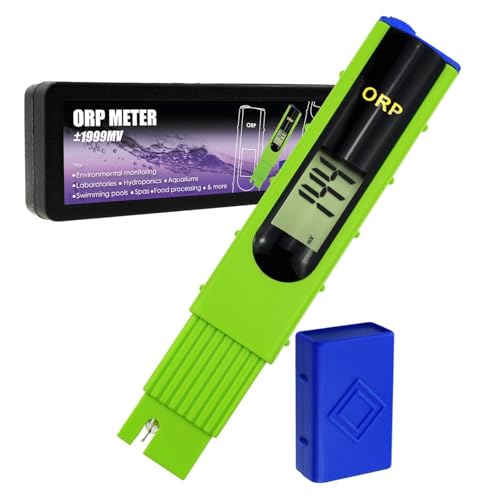
ORP Meter for Water Pen-Type ORP Meter Redox Tester with ATC Function Digital Water Quality Tester Oxidation Reduction Potential Meter ±1999mV Measuring Range for Drinking Water Hydroponics Aquariums
- Wide Measurement Range: -1999 to 1999 mV with 1 mV steps
- Automatic Temperature Compensation: ATC function for 0-50°C water
- Simple Calibration: One-point calibration with distilled water
As an affiliate, we earn on qualifying purchases.
As an affiliate, we earn on qualifying purchases.
Conclusion
Understanding ORP helps you gauge water quality effectively. Did you know that a typical healthy body’s ORP ranges between +200 to +300 millivolts? Keeping an eye on this value ensures your water stays balanced and safe for consumption. By monitoring ORP regularly, you can quickly identify potential issues before they become serious. So, stay proactive—knowing your water’s ORP isn’t just smart, it’s vital for maintaining ideal health and safety.

Bluelab ORP Meter, Handheld Water Quality Tester
- Water Quality Monitoring: Tracks ORP to prevent biofouling and failures
- Compact & Easy to Use: Handheld design with backlit display and auto-off
- Reliable ORP Measurement: Includes replaceable BNC probe with hydration cap
As an affiliate, we earn on qualifying purchases.
As an affiliate, we earn on qualifying purchases.

Bante 221 Portable pH ORP Meter | Handheld pH Meter | Equipped with pH and ORP Electrodes | Accuracy ±0.002 pH, ±0.2 mV | 500 Sets of Data Storage
- Measurement Modes: pH, mV, and relative mV modes
- Calibration: 1-5 point auto-recognition calibration
- Calibration Log: Displays offset and electrode slopes
As an affiliate, we earn on qualifying purchases.
As an affiliate, we earn on qualifying purchases.