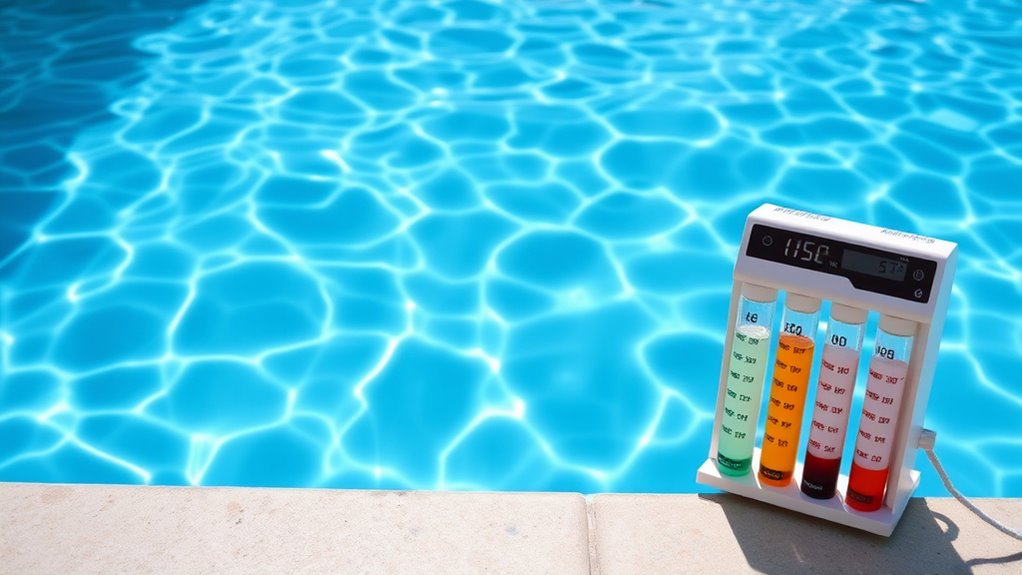

To keep your saltwater pool safe and inviting, you need to closely monitor and maintain proper water chemistry. Test salt levels weekly and adjust with salt or water to stay within the recommended range. Keep pH between 7.2 and 7.6 by using pH increasers or decreasers; this prevents equipment damage and skin irritation. Regular testing and adjustments help prevent cloudy water, algae, and bacterial growth, ensuring your pool remains clean and healthy. Learning more will help you master your pool’s chemistry.
Key Takeaways
- Regularly test and maintain salt levels within the recommended range to ensure proper sanitizer production.
- Keep pH levels between 7.2 and 7.6 for optimal water balance and equipment protection.
- Adjust salt and pH levels promptly using appropriate chemicals or additives based on test results.
- Monitor water chemistry weekly to prevent issues like cloudiness, scaling, or equipment damage.
- Consistently balance water chemistry to promote clear, safe, and comfortable swimming conditions.
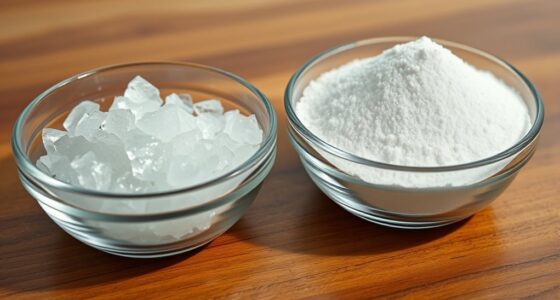
Maintaining proper water chemistry is vital for keeping your saltwater pool clean, safe, and comfortable to swim in. One of the key aspects of this is ensuring the salt level stays within the recommended range. Salt level maintenance isn’t just about adding salt when the reading is low; it’s about regularly testing your water to prevent it from becoming too salty or not salty enough. If the salt level drops, your salt chlorine generator won’t produce enough sanitizer, leading to potential algae growth and bacteria buildup. Conversely, if the salt level is too high, it can cause cloudy water, scaling on pool surfaces, and even damage to the generator. To keep things balanced, you should test your salt levels weekly using reliable test strips or a digital meter, adjusting with salt or water as needed.
Alongside salt level maintenance, pH balancing plays a vital role in maintaining a healthy saltwater pool. The pH level indicates how acidic or alkaline your water is, and it should ideally stay between 7.2 and 7.6. If the pH drops below this range, your water becomes more acidic, leading to corrosion of pool equipment, etching of your pool surface, and skin or eye irritation for swimmers. If it rises too high, the water becomes alkaline, which can cause cloudy water, scale formation, and reduce the effectiveness of chlorine. Regular testing at least twice a week allows you to detect fluctuations early. You can then adjust the pH with pH increasers or decreasers, which are readily available at pool supply stores. Proper pH balancing ensures your saltwater system functions efficiently, and your water remains comfortable and safe for swimmers.
Balancing salt levels and pH isn’t a one-time task; it’s an ongoing process. As your pool experiences use, evaporation, rain, and other environmental factors, water chemistry can shift quickly. Maintaining a consistent testing routine helps you catch imbalances before they become serious problems. When you test, pay close attention to both salt and pH, adjusting accordingly to keep them within the proper ranges. Doing so ensures your saltwater pool remains sanitized, clear, and inviting. Remember, good water chemistry doesn’t just protect your pool equipment; it also safeguards your health and enhances the overall swimming experience. By staying vigilant with salt level maintenance and pH balancing, you’ll enjoy a sparkling, healthy pool throughout the swimming season.
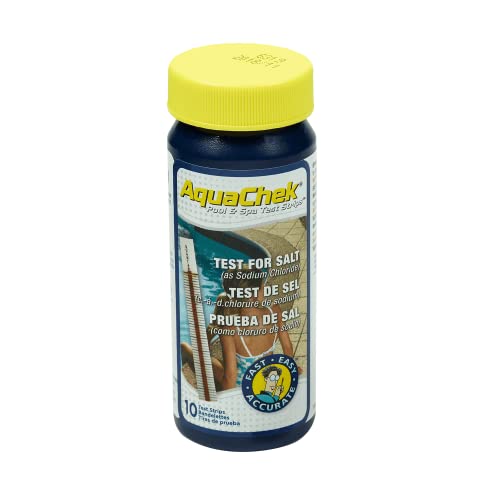
AquaChek Salt Test Strip Titrators for Pools – Salt Water Pool Test Strips for Sodium Chloride – Quick and Accurate Results – Professional Water Quality Testing Kit (10 Strips)
WHITE SALT TEST STRIPS: Tests the salt (sodium chloride) levels for pools with salt generator systems; White titrators…
As an affiliate, we earn on qualifying purchases.
As an affiliate, we earn on qualifying purchases.
Frequently Asked Questions
How Often Should I Test My Saltwater Pool’s Water Chemistry?
You should test your saltwater pool’s water chemistry at least twice a week, especially during peak use or hot weather. Follow a consistent testing schedule to monitor chemical levels like pH, alkalinity, and chlorine. Regular testing helps you maintain a safe, balanced environment, prevents issues like corrosion or algae growth, and guarantees your saltwater system works efficiently. Adjust chemical levels as needed based on your test results for ideal pool health.
What Are Common Signs of Imbalanced Water Chemistry?
Like a ship without a compass, your pool shows signs of imbalance through pH fluctuations and algae growth. You’ll notice cloudy water, a strong chlorine smell, or skin and eye irritation. If algae start to bloom or the water becomes slimy, it’s a clear sign to test and adjust your chemicals promptly. Regular monitoring keeps your pool safe, clear, and inviting, preventing small issues from turning into bigger problems.
Can I Use Regular Pool Chemicals in a Saltwater Pool?
Yes, you can use regular pool chemicals in a saltwater pool, but you need to guarantee they are chemically compatible. Proper pool maintenance requires checking labels and avoiding chemicals that could react negatively with your salt system. Use chlorine or stabilizers designed for saltwater pools whenever possible. Always follow manufacturer instructions to maintain water balance and avoid damage to your salt generator. Regular chemical adjustments help keep your pool safe and clear.
How Does Temperature Affect Saltwater Pool Chemistry?
Imagine your saltwater pool as a delicate dance, where temperature fluctuations play a vital role. When it’s hot outside, your pool’s chemistry shifts, reducing salt stability and making chlorine less effective. Cold temperatures slow down chemical reactions, affecting pH and alkalinity. You need to monitor these changes closely, adjusting your chemical levels to keep the water balanced and safe, ensuring your pool remains inviting and crystal clear year-round.
What Are the Long-Term Effects of Salt on Pool Equipment?
Salt can cause corrosion over time, impacting your pool equipment’s lifespan. To prevent this, you should focus on corrosion prevention by regularly checking and maintaining your equipment, applying protective coatings, and using corrosion-resistant materials. Proper maintenance extends equipment lifespan and keeps your saltwater system running smoothly. Being proactive about corrosion prevention guarantees your pool remains in good condition, saving you money and hassle in the long run.
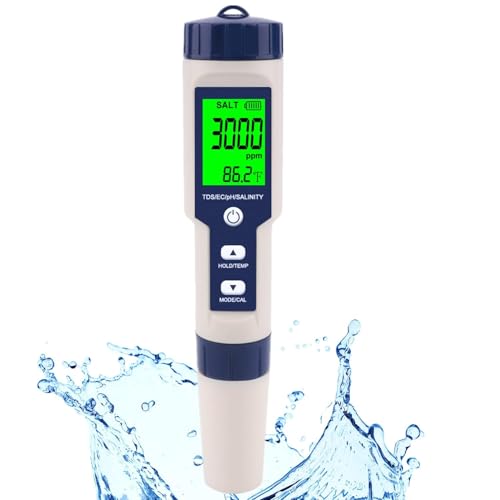
Pool Salt Tester & PH Meter, Hofun Digital Salinity Meter and PH Tester for Aquarium and Pool Saltwater Water, 5 in 1 Salinity PH Temp EC and TDS Meter, Aquarium Swimming Pool Hot Tub, High Accuracy
Wide Usage PH Meter : Hofun ph meter is an essential tool to improve your life quality. This…
As an affiliate, we earn on qualifying purchases.
As an affiliate, we earn on qualifying purchases.
Conclusion
Maintaining water chemistry in your saltwater pool keeps it shining like a jewel in your backyard. By regularly testing and balancing your water, you prevent issues from sneaking up like shadows at dusk. Think of it as tending a delicate garden—each adjustment helps your pool stay clear, safe, and inviting. With proper care, you’ll enjoy sparkling, inviting water that turns your swimming experience into a invigorating escape, as vibrant as a sunset on a calm evening.

Pool Mate 10-Pounds Premium pH Up for Pools, 100% Sodium Carbonate
Sodium carbonate for pools
As an affiliate, we earn on qualifying purchases.
As an affiliate, we earn on qualifying purchases.

Clorox® Pool&Spa™ Swimming Pool pH Down, Lowers pH, Protects Against Eye and Skin Irritation, 5LB (Pack of 1)
Lowers High pH: Clorox Pool&Spa Swimming Pool pH Down is formulated to restore neutral pH in pool water….
As an affiliate, we earn on qualifying purchases.
As an affiliate, we earn on qualifying purchases.