
To minimize friction losses in your piping system, use a hydraulic head loss calculator to assess factors like pipe roughness, flow velocity, and fittings. Opt for smoother pipe materials such as PVC, and keep flow speeds within recommended ranges to reduce turbulence. Properly designing your system with appropriate pipe diameters and minimizing bends or fittings also helps lower head loss. Continuing further will reveal how to optimize these aspects for maximum efficiency.
Key Takeaways
- Use accurate pipe roughness data and flow parameters to calculate head loss precisely and identify areas for improvement.
- Select smoother pipe materials (e.g., PVC) to reduce interior roughness and minimize frictional energy losses.
- Optimize flow velocity by increasing pipe diameter or adjusting flow rates to lower head loss.
- Reduce fittings, bends, and valves or use streamlined designs to decrease additional frictional losses.
- Employ head loss calculators to compare scenarios and select configurations that minimize friction and energy consumption.
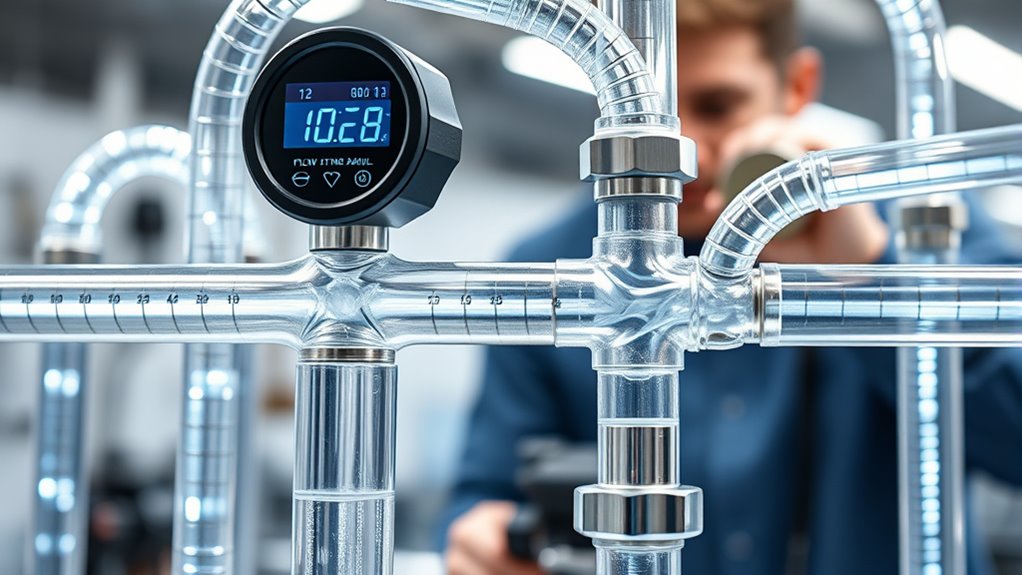
Understanding hydraulic head loss is essential for designing efficient piping systems, as it determines how much energy is lost as water flows through pipes, fittings, and other components. One key factor influencing head loss is pipe roughness. The surface texture inside the pipe affects how water moves; smoother pipes generate less friction, resulting in lower head loss, while rougher pipes increase turbulence and energy dissipation. When selecting pipe materials, consider how their roughness impacts flow resistance. For example, PVC pipes usually have a smoother interior surface than cast iron, which translates to reduced head loss. Recognizing this helps you optimize pipe selection to minimize energy consumption and improve system efficiency. Additionally, understanding the flow regime—whether laminar or turbulent—can help predict and manage head loss more accurately.
Flow velocity plays a significant role in head loss calculations. As water speeds up, the frictional forces between the fluid and pipe wall intensify, leading to higher energy losses. If you increase flow velocity beyond recommended levels, head loss rises exponentially, making your system less efficient and potentially causing pressure drops. To keep head loss manageable, you need to control flow velocity within ideal ranges. This involves balancing flow rates with pipe diameter and length to prevent excessive turbulence. For example, in high-flow scenarios, increasing pipe diameter can reduce flow velocity, thereby decreasing head loss and conserving energy.
Understanding the relationship between pipe roughness and flow velocity allows you to fine-tune your piping system. When designing or retrofitting, aim for a smooth pipe interior and choose appropriate diameters to maintain moderate flow velocities. This approach minimizes the frictional resistance and reduces the need for additional pumping power, saving operational costs. Keep in mind that head loss isn’t solely about pipe material; fittings, valves, and bends also contribute to overall frictional losses. However, controlling pipe roughness and flow velocity gives you a solid foundation for reducing head loss throughout the entire system.

Lswteiz 10Pack 3/4" Double Female Thread PVC Pipe Coupling Adapter Pipe Fitting Connector (F x F) SCH40 3/4Inch PVC Female Threaded Pipe Coupling for Sprinkler,Irrigation,Swimming Pools
【PVC Female Coupling】FNPT female threads on both ends for connecting two pipes or PVC fittings with MNPT male…
As an affiliate, we earn on qualifying purchases.
As an affiliate, we earn on qualifying purchases.
Frequently Asked Questions
How Often Should I Recalibrate My Head Loss Calculator?
You should recalibrate your head loss calculator annually or whenever you notice discrepancies in your measurements. Incorporate calibration frequency into your maintenance schedule to guarantee accuracy. Regular calibration helps account for sensor drift or wear and tear, maintaining precise friction loss calculations. By staying consistent with this process, you’ll minimize errors and optimize your system’s efficiency, ensuring reliable results every time you assess hydraulic head losses.
Can the Calculator Account for Pipe Wear and Corrosion?
Your calculator can’t automatically account for pipe wear and corrosion effects. These issues increase friction losses over time, so you need to manually update your data or input new pipe conditions periodically. Regular inspections and measurements help you track pipe deterioration. By doing this, you guarantee your calculations stay accurate, reflecting real-world conditions, especially as pipe wear and corrosion impact flow efficiency and head loss estimates.
What Is the Maximum Pipe Length the Calculator Can Handle?
The maximum pipe length the calculator can handle depends on its capacity and the specific input parameters you provide. Typically, it can manage pipe lengths up to several thousand meters, but extremely long pipe systems might require more advanced modeling or segmentation. To guarantee accurate results, stay within the recommended pipe length limits for your calculator, and break down longer distances into manageable sections if needed.
Does the Calculator Consider Temperature Variations in Water?
No, the calculator doesn’t directly consider water temperature variations, but it accounts for changes in the friction coefficient caused by temperature. As water temperature increases, the friction coefficient typically decreases, reducing head loss. You should input the specific water temperature to get an accurate friction coefficient, ensuring your calculations reflect real-world conditions. This way, your results will be more precise, especially in systems with varying water temperatures.
Can It Predict Head Loss for Non-Standard Pipe Materials?
Sure, your fancy calculator can handle non-standard materials for head loss predictions—if it’s programmed to do so, that is. Usually, these tools rely on standard data, so predicting head loss for non-standard materials might be a stretch unless you input specific properties. So, if you’re dealing with weird pipes, don’t expect perfect accuracy—just a rough estimate, and maybe a prayer.
hydraulic head loss calculator
As an affiliate, we earn on qualifying purchases.
As an affiliate, we earn on qualifying purchases.
Conclusion
Knowing how to calculate hydraulic head loss helps you minimize friction and save energy. Did you know that reducing head loss by just 10% can cut pumping costs by up to 15%? By using the right calculator and understanding flow dynamics, you can optimize your system’s efficiency and prevent costly damages. Keep these insights in mind, and you’ll be better equipped to manage your hydraulic systems effectively, ensuring smooth operation and long-term savings.

FlowVis FV-2 Flow Meter with Check Valve and Velocity Scale for 2" Schedule 40 Pipe. Scale in GPM.
Installation flexibility; installs horizontally, vertically, or even upside-down
As an affiliate, we earn on qualifying purchases.
As an affiliate, we earn on qualifying purchases.

Pipe, Fittings, Valves, Supports, and Fasteners
As an affiliate, we earn on qualifying purchases.
As an affiliate, we earn on qualifying purchases.