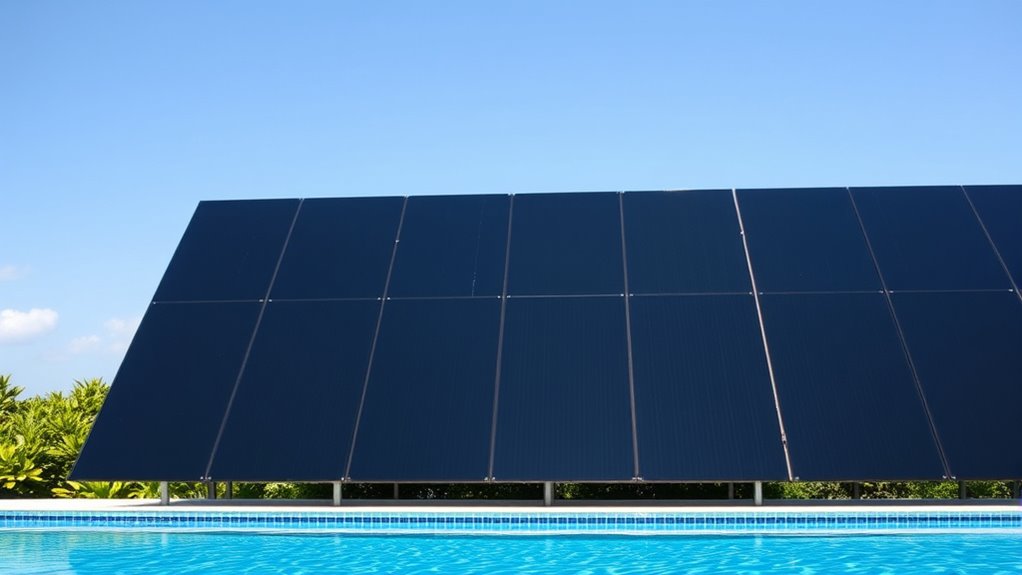

To size your solar collectors, measure your pool’s surface area and install 50-100% of it in solar collectors—so for an 800 sq ft pool, aim for 400 to 800 sq ft of collectors. Adjust the tilt based on the season—set closer to your latitude for summer and tilt higher (latitude + 10-15°) for winter. Proper sizing and tilt maximize efficiency; continue exploring for detailed calculations and optimization tips.
Key Takeaways
- Calculate pool surface area and install 50-100% as collector area, e.g., 400-800 sq ft for an 800 sq ft pool.
- Set collector tilt around latitude plus 10-15° in winter and near latitude in summer for optimal solar gain.
- Adjust tilt seasonally or fix at an angle close to your latitude for balanced year-round performance.
- Position collectors to avoid shading during peak sun hours (9 a.m. to 3 p.m.) for maximum efficiency.
- Proper sizing and tilt enhance solar energy absorption, reducing reliance on auxiliary heating sources.
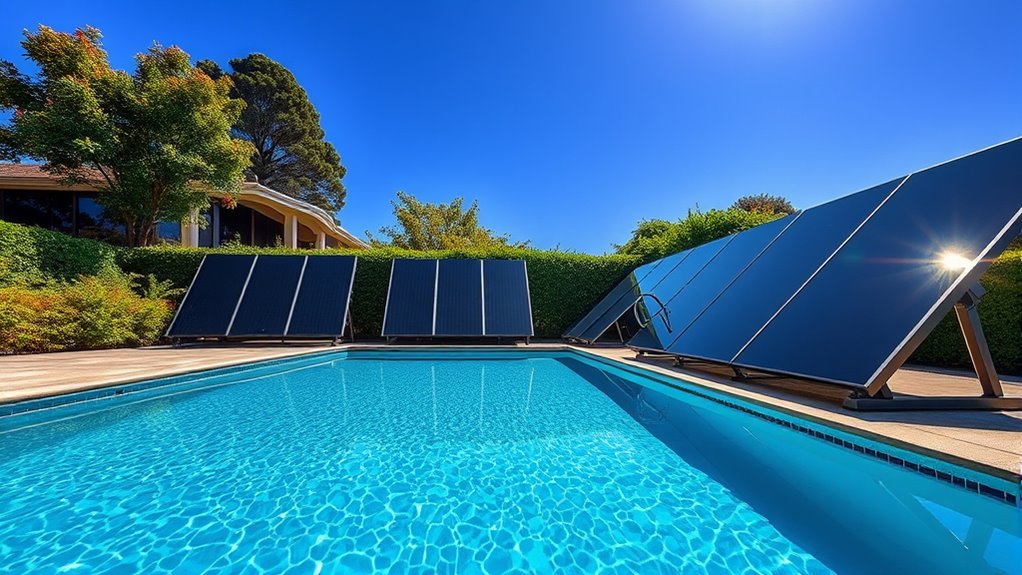
Are you looking for an eco-friendly way to keep your pool warm while saving money? Solar thermal systems are an excellent choice, and understanding how to determine your collector area and tilt angle is key to maximizing efficiency. First, you’ll want to figure out the size of your collector area. This involves calculating how much solar energy your pool needs to stay warm throughout the year, which depends on your pool’s size, your local climate, and how much you use your pool. A common rule of thumb is to install about 50-100% of your pool’s surface area in solar collectors. For example, if your pool measures 20 feet by 40 feet, its surface area is 800 square feet. Installing a collector area between 400 and 800 square feet generally provides sufficient thermal gain. However, this range can vary based on your location and desired water temperature. If you live in a cooler climate or want your pool warmer for longer periods, leaning towards the higher end of that range makes sense.
Once you’ve decided on the collector size, the next step is adjusting the tilt angle. The tilt influences how much solar energy your collectors absorb. The goal is to position them to face the sun as directly as possible, which depends on your geographic latitude. As a general rule, during winter months, tilt your collectors roughly equal to your latitude plus 10 to 15 degrees to optimize heat absorption. For example, if you’re at 40° north latitude, set your collectors at about 50° to 55°. During summer, a lower tilt angle closer to your latitude — around 40° — will maximize summer collection. Some systems incorporate adjustable mounts, allowing you to change the tilt seasonally to optimize performance year-round. If you prefer a fixed system, aim for a tilt angle that balances performance across seasons, often close to your latitude.
Getting the tilt right also helps prevent snow accumulation and debris buildup, reducing maintenance and ensuring continuous solar gain. Remember, shading from nearby trees or structures can considerably impact your system’s efficiency. Position your collectors where they are least shaded during peak sunlight hours, typically between 9 a.m. and 3 p.m. For most homeowners, a simple calculation based on latitude provides a solid starting point, but fine-tuning based on your specific site conditions can boost performance. Additionally, selecting high-quality solar collectors can further enhance your system’s efficiency and durability. With proper sizing and tilt adjustment, your solar thermal system will capture maximum sunlight, effectively heating your pool while reducing reliance on electricity or gas. This way, you enjoy warm, inviting water without harming the environment or stretching your budget.
Frequently Asked Questions
How Does Shade Affect Solar Thermal Pool Performance?
Shade considerably diminishes your solar thermal pool’s performance by blocking sunlight from reaching the collector. When shaded, your system absorbs less energy, resulting in slower water heating or no heating at all. To maximize efficiency, you should position your collectors where they receive full sun exposure, ideally avoiding trees, buildings, or other obstructions. Regularly trim nearby foliage and consider strategic placement to guarantee ideal sunlight throughout the day.
Can Solar Thermal Systems Work in Winter?
Yes, solar thermal systems can work in winter, but their efficiency drops due to shorter days, lower sun angles, and colder temperatures. You might need a larger collector area or a backup heating system to maintain your pool temperature. Keep your collectors free of snow and debris, and consider using a pool cover to retain heat. With proper setup, you can extend your swimming season into colder months.
What Is the Lifespan of a Solar Thermal Collector?
They say “a stitch in time saves nine,” and it’s true for solar thermal collectors—they typically last 15 to 20 years with proper maintenance. You’ll want to keep an eye on corrosion, leaks, and efficiency drops, and schedule regular inspections. Quality collectors often come with warranties, giving you peace of mind. Proper upkeep guarantees you get the most out of your investment for many years to come.
Are There Government Incentives for Solar Thermal Pools?
Yes, many governments offer incentives for solar thermal pools, including tax credits, rebates, and grants. These programs aim to encourage renewable energy use and reduce your energy costs. You should check with your local or national agencies, as incentives vary by location and may have specific eligibility requirements. Taking advantage of these incentives can considerably lower your upfront investment and make solar thermal systems more affordable.
How Often Should Solar Thermal Collectors Be Maintained?
Think of your solar thermal collectors like a car engine—they need regular check-ups to keep running smoothly. You should inspect and clean your collectors at least once a year, especially after winter or heavy storms. Look for dirt, debris, or damage that could block sunlight. Proper maintenance guarantees peak performance, saving you money and extending your system’s lifespan. Regular care keeps your pool warm and your energy bills lower.
Conclusion
So, after all that math, it’s clear that a perfectly tilted collector isn’t magic—it’s just good planning. But don’t get too comfortable thinking you’ve cracked the code; even the best setup can be thrown off by cloudy days or unexpected weather. So, while maximizing collector area and tilt helps, remember, no system is foolproof. Sometimes, the sun’s generosity just isn’t enough—proof that even solar power has its limits.