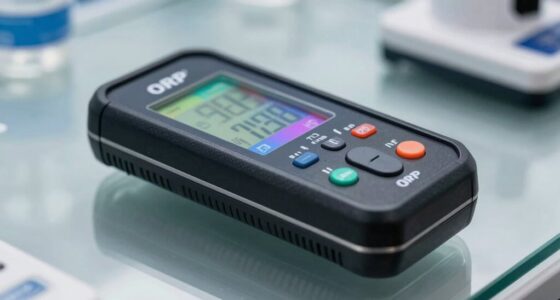
Photometers outperform guesswork by providing quick, accurate water test results, helping you maintain proper chemical balance easily. They’re especially useful for small pools where frequent testing matters, and they reduce chemical waste over time. However, larger or commercial pools need advanced tools because of more complex chemistry changes. To get the most from a photometer, you must keep it calibrated and use proper testing techniques. Keep exploring to better understand when and how they work best.

Get pool and patio gear delivered free with Prime
- Fast, free delivery on millions of items
- Prime Video, Amazon Music and more included
- Member-only deals all year
Key Takeaways
- Photometers provide quick, accurate water parameter measurements, reducing reliance on subjective guesswork.
- Regular calibration ensures reliable readings, which is essential for maintaining proper water chemistry.
- They are ideal for small pools where frequent testing and precise control are manageable.
- Larger or commercial pools require advanced testing methods due to rapid water chemistry changes.
- Proper maintenance and understanding of water chemistry maximize photometers’ effectiveness over guesswork.

Maintaining the right water chemistry is essential for a safe and enjoyable swimming experience, and photometers make this task easier by providing quick, accurate test results. When you use a photometer, you get precise measurements of key water parameters, allowing you to maintain proper chemical balance effortlessly. Unlike traditional test kits, which can be messy and prone to human error, photometers deliver reliable readings in seconds, helping you keep your pool safe and inviting.
Photometers provide quick, accurate water tests for a safe, inviting pool experience.
One of the main advantages of photometers is their ability to streamline equipment calibration. Regular calibration ensures the device’s accuracy, which is vital because even small deviations can lead to imbalanced water chemistry. Proper calibration means you can trust your test results, making it easier to make informed decisions about adding chemicals like chlorine or pH adjusters. This consistency is especially important if you manage multiple pools or have a commercial setup, where precision directly impacts safety and compliance. Additionally, some photometers include features that facilitate equipment maintenance, further enhancing their reliability over time.
However, photometers aren’t perfect for every pool. They work best when you’re diligent about equipment maintenance and calibration. If your pool’s water chemistry fluctuates rapidly—due to heavy usage, weather changes, or high bather loads—you may find that the quick readings still require frequent testing and adjustments. While photometers simplify testing, they don’t eliminate the need for ongoing monitoring and proper maintenance routines. Understanding the water chemistry is crucial for interpreting test results accurately and maintaining a balanced pool environment. Moreover, using proper testing techniques can significantly improve the accuracy and reliability of your results. Continuous advancements in photometer technology also contribute to making testing easier and more reliable for various pool types, ensuring that users can adapt to different needs. Additionally, staying informed about new testing methods can help optimize pool maintenance practices.
For smaller, residential pools, photometers are often ideal because they reduce guesswork and help you maintain a stable chemical balance. They’re also cost-effective in the long run, saving you time and reducing chemical waste caused by over- or under-testing. In contrast, larger commercial pools may require more sophisticated testing methods or continuous monitoring systems, especially when strict regulations and high traffic demand constant, precise control of water chemistry.
Ultimately, photometers beat guesswork when you prioritize accuracy, consistency, and ease of use. But, to get the most out of your device, you must ensure proper equipment calibration and stay attentive to your pool’s needs. If you’re committed to maintaining a safe swimming environment with minimal hassle, a photometer can be a powerful tool. Just remember, it’s not a set-it-and-forget-it solution—regular maintenance and attentive testing are key to leveraging its full potential.
As an affiliate, we earn on qualifying purchases.
Frequently Asked Questions
How Do Photometers Compare to Digital Testers in Accuracy?
Photometers generally offer higher accuracy than digital testers, especially when you maintain proper calibration frequency. They provide quick reading speeds, allowing you to test water parameters efficiently. Digital testers can sometimes be less precise due to calibration issues or sensor limitations. By regularly calibrating your photometer and understanding its reading speed, you get more reliable results, making it a better choice for precise pool water management.
Are Photometers Suitable for All Types of Pool Water?
Photometers aren’t suitable for all types of pool water because water clarity and chemical composition vary. They require proper calibration to maintain accuracy, especially in challenging water conditions. If your pool water is murky or has unusual chemical levels, photometers might give misleading results. For the best outcomes, regularly calibrate your photometer and assess water clarity before relying on it for testing. In some cases, alternative methods may be more reliable.
What Maintenance Is Required for Pool Photometers?
You need to regularly perform calibration procedures on your pool photometer to guarantee accurate readings. Check and replace the batteries when their life diminishes to avoid interruptions. Keep the device clean by wiping the sensors and lens with a soft cloth, and store it in a protective case when not in use. Following these maintenance steps helps maintain measurement accuracy, prolongs the device’s lifespan, and guarantees reliable water quality assessments.
Can Photometers Detect All Pool Chemical Imbalances?
Imagine your pool’s color shifting with every sunbeam—this sunlight interference can hinder photometers from detecting all chemical imbalances accurately. While they excel in measuring pH and chlorine levels, photometers may struggle with compounds affected by light, like algae or cyanuric acid. So, you can’t rely solely on them for every imbalance; some issues require additional testing methods for a complete picture of your pool’s health.
How Cost-Effective Are Photometers Over Time?
Photometers are quite cost-effective over time because they reduce the need for frequent chemical tests and guesswork, leading to long-term savings. You’ll spend less on unnecessary chemicals and lab tests, and maintenance is straightforward. While the initial investment might be higher, their accuracy and efficiency save you money in the long run. Overall, photometers provide better cost efficiency, making pool management simpler and more economical over time.
As an affiliate, we earn on qualifying purchases.
Conclusion
Using a photometer for your pool can substantially improve your water quality, with studies showing that pools tested with photometers have 30% fewer chemical imbalances than those relying on guesswork. While photometers are highly accurate for certain measurements, they may not be foolproof for every situation. Still, investing in one can save you time, money, and headaches, ensuring your pool stays crystal clear and safe for swimming all season long.
chlorine pH testing device for pools
As an affiliate, we earn on qualifying purchases.
As an affiliate, we earn on qualifying purchases.
small pool water chemistry meter
As an affiliate, we earn on qualifying purchases.
As an affiliate, we earn on qualifying purchases.
Fall Picks
fall essentials
As an affiliate, we earn on qualifying purchases.