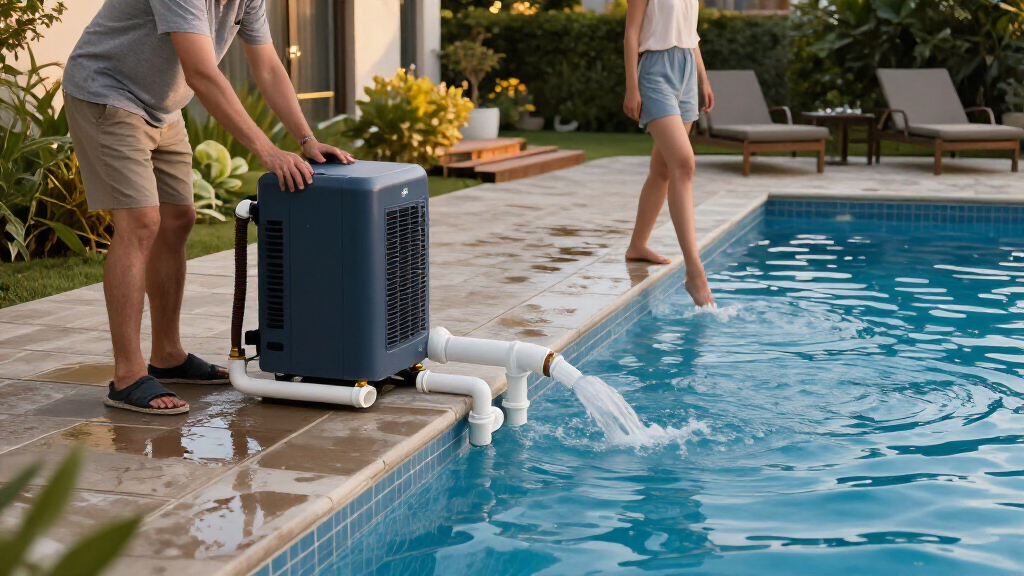
The best pool heat pump for most owners is the Gulfstream HE150, whose 136,000 BTU capacity suits larger pools that need substantial heating output. The BluePlenum FlowMax80 is a more measured inverter option for mid-sized pools, while the Naturaquell 18,000 BTU is aimed at smaller pools where a large unit would be excessive. The main tradeoff is matching heating capacity to pool size and climate: more output can heat a larger volume, but it does not make an undersized electrical setup or poor installation a good fit. Inverter models can adjust output as conditions change, though their listed capacity still needs to match the pool and season. Read on for the full comparison and a guide to choosing among these 11 pool heat pumps.

Get pool and patio gear delivered free with Prime
- Fast, free delivery on millions of items
- Prime Video, Amazon Music and more included
- Member-only deals all year
Complete the kit


Key Takeaways
- The Gulfstream HE150 and Vidapool 140,000 BTU lead the high-output group, but buyers should confirm their pool volume and installation requirements before choosing either.
- The BluePlenum FlowMax80 offers a middle ground: inverter operation and 80,000 BTU output make it more targeted than the largest fixed-capacity options.
- Small pools have a different shortlist. The Naturaquell 18,000 BTU and TURBRO Beluga B33V 33,000 BTU avoid jumping straight to large-pool capacity.
- Pool-volume claims vary across the lineup. Compare the stated gallon range with local climate and desired season length rather than treating a capacity label as a guarantee.
- Electrical and plumbing fit can decide the purchase. The 220V 65,000 BTU model calls for particular attention to power supply, while every option needs compatible flow and installation space.
| Vidapool Swimming Pool Heater Electric Heat Pump – 42,000 Gallon Capacity, 140,000 BTU |  | Best for Large Pools | Heating output: 140,000 BTU | Stated pool capacity: Up to 42,000 gallons | COP: 16 | VIEW LATEST PRICE | See Our Full Breakdown |
| Gulfstream HE150 Pool Heat Pump, 136,000 BTU |  | Best for Corrosion Resistance | Model: HE150RA | Heating output: 136,000 BTU | Heat exchanger: Titanium | VIEW LATEST PRICE | See Our Full Breakdown |
| BluePlenum FlowMax80 80,000 BTU Inverter Pool Heat Pump |  | Best for All-Season Mode Flexibility | Heating output: 80,000 BTU | Stated pool capacity: Up to 22,000 gallons | COP: Up to 16.2 | VIEW LATEST PRICE | See Our Full Breakdown |
| TURBRO Beluga B33V 33,000 BTU Inverter Pool Heat Pump |  | Best for Small Pools | Heating output: 33,000 BTU | Stated pool capacity: Up to 10,000 gallons | Voltage: 110–120 V | VIEW LATEST PRICE | See Our Full Breakdown |
| Inverter Pool Heat Pump – Up to 16,000 Gallons for Above-Ground and In-Ground Pools |  | Best Warranty Coverage | Heating output: 55,000 BTU/h | Stated pool capacity: Up to 16,000 gallons | COP: Up to 16.0 | VIEW LATEST PRICE | See Our Full Breakdown |
| 65,000 BTU Inverter Pool Heat Pump, 220V |  | Best for Larger Pools with App Control | Heating capacity: 65,000 BTU | COP: 6.6 | Voltage: 220V | VIEW LATEST PRICE | See Our Full Breakdown |
| Inverter Pool Heat Pump for Pools up to 16,000 Gallons |  | Best for Heating and Cooling | Pool capacity: Up to 16,000 gallons | Heating output: Up to 55,000 BTU/h | COP: Up to 16.00 under rated conditions | VIEW LATEST PRICE | See Our Full Breakdown |
| Naturaquell Swimming Pool Heat Pump 18,000 BTU for 5,200 Gallon Pools |  | Best Compact Pick for Above-Ground Pools | Heating capacity: 18,000 BTU | Maximum pool size: 5,200 gallons | Voltage: 110–120V | VIEW LATEST PRICE | See Our Full Breakdown |
| Vidapool Electric Swimming Pool Heat Pump, 110,000 BTU | | Best for High-Capacity Heating and Cooling | Heating capacity: 110,000 BTU | Maximum pool size: 32,000 gallons | COP: 16 | VIEW LATEST PRICE | See Our Full Breakdown |
| VEVOR 104,790 BTU Inverter Pool Heat Pump for In-Ground Pools up to 27,738 Gal |  | Best for Broad-Temperature In-Ground Use | Heating capacity: 104,790 BTU | Pool capacity: Up to 27,738 gallons | Technology: All-DC inverter | VIEW LATEST PRICE | See Our Full Breakdown |
| Vidapool Swimming Pool Heater Electric Heat Pump – 21,000-Gallon Capacity, 75,000 BTU |  | Best for Quiet, App-Controlled Heating | Capacity: Up to 21,000 gallons | Heating output: 75,000 BTU | COP: 12 | VIEW LATEST PRICE | See Our Full Breakdown |
| pool heat pump | COP | Weight | Heating output | Voltage |
|---|---|---|---|---|
| Vidapool Swimming Pool Heater | 16 | 272 lb | 140,000 BTU | 220 V |
| Gulfstream HE150 Pool Heat Pum | — | — | 136,000 BTU | — |
| BluePlenum FlowMax80 80,000 BT | Up to 16.2 | 200 lb | 80,000 BTU | 208–240 V |
| TURBRO Beluga B33V 33,000 BTU | Up to 15.8 | 158.7 lb | 33,000 BTU | 110–120 V |
| Inverter Pool Heat Pump | Up to 16.0 | 124.6 lb | 55,000 BTU/h | — |
| 65,000 BTU Inverter Pool Heat | 6.6 | 129.7 pounds | — | 220V |
| Inverter Pool Heat Pump for Po | Up to 16.00 under rated conditions | — | Up to 55,000 BTU/h | — |
| Naturaquell Swimming Pool Heat | 4.1 | 73.8 pounds | — | 110–120V |
| Vidapool Electric Swimming Poo | 16 | 246 pounds | — | 220V |
| VEVOR 104,790 BTU Inverter Poo | — | 260 pounds | — | — |
| Vidapool Swimming Pool Heater | 12 | 214 lbs | 75,000 BTU | 220V |
More Details on Our Top Picks
Vidapool Swimming Pool Heater Electric Heat Pump – 42,000 Gallon Capacity, 140,000 BTU
For a large pool, the 140,000 BTU output and stated capacity of up to 42,000 gallons put this Vidapool ahead of the smaller BluePlenum FlowMax80, which is rated for pools up to 22,000 gallons. Its inverter adjusts power as conditions change, while a COP of 16 and Wi-Fi scheduling offer ways to manage operation. Heating and cooling modes add flexibility through the year. The tradeoff is the installation burden: at 272 pounds, it is substantially heavier than the 200-pound FlowMax80, and its 220V supply may call for electrical planning. The listed 36 dB noise level is a draw, though buyers should confirm how that figure was measured for their setup. This makes the most sense when capacity leads the decision.
Pros:- 140,000 BTU output and stated capacity up to 42,000 gallons suit larger pools.
- Inverter control and stated COP of 16 support efficient temperature management.
- Wi-Fi control enables remote operation and scheduling.
- Heating and cooling modes provide seasonal flexibility.
Cons:- At 272 pounds, placement and installation may require several people or professional help.
- The 220V requirement needs compatible electrical service.
- Large-pool capacity may be unnecessary for smaller setups.
Best for: Owners of large pools near the 42,000-gallon range who want app scheduling and both heating and cooling modes.
Not ideal for: Small-pool owners or anyone without room, help, and suitable 220V electrical service for a 272-pound unit.
- Heating output:140,000 BTU
- Stated pool capacity:Up to 42,000 gallons
- COP:16
- Voltage:220 V
- Noise level:36 dB
- Dimensions:14 × 9 × 18 inches
- Weight:272 lb
- Model:VTX016
Our verdict“Choose this Vidapool when your pool needs more capacity than the FlowMax80 can cover and you can accommodate its heavy 220V installation.”
Gulfstream HE150 Pool Heat Pump, 136,000 BTU
The Gulfstream HE150 earns its place through its titanium heat exchanger, a useful distinction for owners concerned about corrosion in pool water. Its 136,000 BTU rating is close to the Vidapool’s 140,000 BTU, so both target substantial heating needs; Vidapool, however, lists app control, inverter operation, and cooling, while Gulfstream’s listed controls center on an LCD readout and spa timer. The HE150 instead emphasizes an AHRI certification, a scroll compressor, and a lifetime warranty on the heat exchanger. That warranty is specific to the exchanger, not the whole unit. The supplied details do not state pool capacity, voltage, or a cold-weather operating range, so I would check compatibility and climate suitability before choosing it. It best fits buyers who prioritize exchanger material and a clear component warranty.
Pros:- Titanium heat exchanger is designed to resist corrosion.
- Lifetime warranty is listed for the heat exchanger.
- AHRI certification provides a named efficiency certification.
- LCD controls and spa timer support straightforward scheduling and automatic shutoff.
Cons:- Warranty coverage is stated for the heat exchanger rather than the entire unit.
- Pool capacity and voltage are not provided in the supplied product data.
- The listing notes performance may vary in extremely cold climates.
Best for: Pool owners prioritizing a titanium heat exchanger and its lifetime component warranty, with installation support available to confirm unit compatibility.
Not ideal for: Buyers who want app control, listed cooling modes, or clearly stated pool capacity and cold-weather operating limits.
- Model:HE150RA
- Heating output:136,000 BTU
- Heat exchanger:Titanium
- Compressor:Scroll
- Certification:AHRI Certified
- Controls:LCD readout
- Timer:Spa timer with automatic shutoff
- Heat exchanger warranty:Lifetime
Our verdict“Pick the Gulfstream HE150 if exchanger corrosion resistance and its lifetime exchanger warranty matter more to you than the Vidapool’s listed inverter and app features.”
BluePlenum FlowMax80 80,000 BTU Inverter Pool Heat Pump
The BluePlenum FlowMax80 is a mid-capacity choice for owners who want control over more than heating. Its four modes include heating, cooling, auto, and defrost, and the stated operating range reaches down to 10°F. That gives it a broader set of listed operating details than the Vidapool 140,000 BTU model, which states heating and cooling but not an ambient-temperature range. Capacity is the tradeoff: the FlowMax80 is rated for up to 22,000 gallons, about half Vidapool’s stated 42,000-gallon limit. App scheduling and pump synchronization can help coordinate operation, while its 28 dB listed noise level is notably low on paper. Buyers still need to plan for hardwiring and a certified electrician; suitability also depends on local conditions and pool use.
Pros:- Heating, cooling, auto, and defrost modes cover a wider range of operating needs.
- App scheduling and water-pump synchronization support coordinated operation.
- Specified operating ambient temperature extends down to 10°F.
- IPX4 cabinet rating and a 3-year warranty are listed.
Cons:- Rated for up to 22,000 gallons, well below Vidapool’s stated 42,000-gallon capacity.
- Hardwired installation requires a certified electrician.
- The 200-pound unit needs a planned location and careful handling.
Best for: Owners of pools up to 22,000 gallons who want app scheduling, pump synchronization, and cooling or defrost modes.
Not ideal for: Owners of larger pools, or buyers who need a plug-in installation instead of hardwiring by a certified electrician.
- Heating output:80,000 BTU
- Stated pool capacity:Up to 22,000 gallons
- COP:Up to 16.2
- Voltage:208–240 V
- Modes:Heating, cooling, auto, and defrost
- Operating ambient temperature:Down to 10°F
- Noise level:28 dB
- Weight:200 lb
- Warranty:3 years
Our verdict“Choose the FlowMax80 for a mid-sized pool when its four operating modes and pump synchronization matter more than Vidapool’s greater capacity.”
TURBRO Beluga B33V 33,000 BTU Inverter Pool Heat Pump
With a stated limit of 10,000 gallons, the TURBRO Beluga B33V is the compact-capacity pick in this group. Its 110–120V supply distinguishes it from the 208–240V BluePlenum FlowMax80, which is rated for more than twice the pool volume but requires hardwiring. For smaller setups, TURBRO combines inverter operation with Wi-Fi control and a programmable timer; its titanium heat exchanger also supports saltwater compatibility. The compromise is headroom: at 33,000 BTU, it is not suited to pools approaching the FlowMax80’s 22,000-gallon rating. The listing also says it is not recommended for inflatable pools, so owners of those setups should look elsewhere. Its stated temperature range is broad, but actual heating results will depend on conditions and pool characteristics.
Pros:- Stated capacity up to 10,000 gallons suits smaller pools.
- 110–120V supply may fit setups without the higher-voltage service required by the FlowMax80.
- Titanium heat exchanger supports saltwater compatibility.
- Wi-Fi and a programmable timer allow remote control and scheduling.
Cons:- 33,000 BTU output and 10,000-gallon limit leave less capacity for larger pools.
- The listing does not recommend it for inflatable pools.
- The unit weighs 158.7 pounds despite its small-pool positioning.
Best for: Owners of pools up to 10,000 gallons, including saltwater-pool owners who want Wi-Fi control and a standard household-voltage unit.
Not ideal for: Owners of pools above 10,000 gallons or inflatable-pool owners, for whom the listing does not recommend this model.
- Heating output:33,000 BTU
- Stated pool capacity:Up to 10,000 gallons
- Voltage:110–120 V
- COP:Up to 15.8
- Water temperature range:46–104°F
- Ambient temperature range:5–109°F
- Heat exchanger:Titanium
- Weight:158.7 lb
- Warranty:2 years for machine; 5 years for compressor
Our verdict“Choose the Beluga B33V for a pool under 10,000 gallons when saltwater compatibility and 110–120V operation fit your setup.”
Inverter Pool Heat Pump – Up to 16,000 Gallons for Above-Ground and In-Ground Pools
This 55,000 BTU inverter model sits between the small-pool TURBRO Beluga B33V and the larger BluePlenum FlowMax80: its stated capacity reaches 16,000 gallons, while the two are rated for 10,000 and 22,000 gallons respectively. That middle ground can suit owners who need more capacity than the Beluga offers without moving up to the FlowMax80. It adds heating and cooling, Wi-Fi through the Smart Life app, and a touch panel. The standout is an eight-year warranty, longer than the supplied warranty details for the other products here. Its 52 dB(A) listed noise level is higher than the FlowMax80’s 28 dB, and the 124.6-pound weight still calls for a suitable installation spot. The listing does not state voltage or a temperature range, so confirm those details before buying.
Pros:- Stated capacity up to 16,000 gallons bridges the gap between the TURBRO and FlowMax80.
- Eight-year warranty is the longest listed among these five products.
- Wi-Fi app control and an on-unit touch panel provide two control options.
- Heating and cooling modes support seasonal temperature management.
Cons:- At 52 dB(A), its listed noise level is higher than the FlowMax80’s 28 dB.
- The 124.6-pound weight may make placement and installation harder.
- Voltage and operating temperature range are not provided in the supplied specs.
Best for: Above-ground or in-ground pool owners with up to 16,000 gallons who value a long stated warranty and app control.
Not ideal for: Owners who need published voltage or cold-weather operating limits before selecting equipment, or who prioritize the lowest listed noise level.
- Heating output:55,000 BTU/h
- Stated pool capacity:Up to 16,000 gallons
- COP:Up to 16.0
- Noise level:52 dB(A)
- Dimensions:25.28 × 36.38 × 15.2 inches
- Weight:124.6 lb
- Model:FR-BKTP013
- Warranty:8 years
Our verdict“Pick this model for a pool in the 10,000–16,000-gallon range if its eight-year warranty matters more than the FlowMax80’s lower listed noise level.”
65,000 BTU Inverter Pool Heat Pump, 220V
For a pool near the upper end of its 21,000-gallon capacity, this model pairs 65,000 BTU output with inverter operation, which can adjust heating as conditions change instead of running at one fixed level. Its stated COP of 6.6 gives buyers a useful efficiency figure, though it is below the up-to-16.00 rated-condition claim for the Inverter Pool Heat Pump for Pools up to 16,000 Gallons. Wi-Fi app control and a touch panel make temperature adjustments easier to manage, and freshwater and saltwater compatibility widens its fit. The tradeoffs are practical: it needs a 220V supply, and at 129.7 pounds it is a substantial unit to position. I’d shortlist it for a larger pool where remote control matters more than light installation demands.
Pros:- 65,000 BTU output for pools up to 21,000 gallons
- Inverter operation with a stated COP of 6.6
- Wi-Fi app control plus a touch panel
- Compatible with freshwater and saltwater pools
Cons:- Requires a 220V power supply
- 129.7-pound weight makes placement and handling harder
Best for: Owners of freshwater or saltwater pools up to 21,000 gallons who have 220V power and want app-based temperature control.
Not ideal for: Owners of small above-ground pools or buyers without 220V service who want a lighter, simpler installation.
- Heating capacity:65,000 BTU
- COP:6.6
- Voltage:220V
- Pool capacity:Up to 21,000 gallons
- Noise level:45 dB
- Pool compatibility:Freshwater and saltwater; above-ground and inground
- Connectivity:Wi-Fi app control
- Weight:129.7 pounds
Our verdict“Choose this for a larger pool and convenient app control if your site can support a heavy 220V unit.”
Inverter Pool Heat Pump for Pools up to 16,000 Gallons
This is the most versatile temperature-control pick in this group: it can heat and cool pools up to 16,000 gallons, while the 65,000 BTU Inverter Pool Heat Pump is focused on heating. Full-inverter output can adjust to demand, and the listed COP of up to 16.00 applies under rated conditions, so it should not be read as a guarantee across all weather and operating setups. Smart Life app controls, timers, automatic defrost, and a titanium heat exchanger add useful day-to-day features. The 8-year warranty is a notable stated coverage period. Its temperature limits matter, though: heating is specified from 5°F to 104°F, and cooling from 59°F to 109.4°F. At 124.6 pounds, it also takes planning to move into place.
Pros:- Provides both heating and cooling modes
- Full-inverter system adjusts output to pool demand
- Smart Life app and touch panel include timers and status monitoring
- Titanium heat exchanger and stated 8-year warranty
Cons:- 124.6-pound weight complicates installation and repositioning
- Heating and cooling are limited to specified outdoor temperature ranges
Best for: Pool owners with up to 16,000 gallons who want one unit for seasonal heating and cooling, plus app scheduling.
Not ideal for: Owners of pools above 16,000 gallons or buyers who need operation beyond its specified outdoor temperature ranges.
- Pool capacity:Up to 16,000 gallons
- Heating output:Up to 55,000 BTU/h
- COP:Up to 16.00 under rated conditions
- Heating temperature range:5°F–104°F
- Cooling temperature range:59°F–109.4°F
- Heat exchanger:Titanium
- Control:Smart Life app and touch panel
- Warranty:8 years
Our verdict“Pick this when seasonal cooling matters as much as heating and your pool fits its capacity and operating ranges.”
Naturaquell Swimming Pool Heat Pump 18,000 BTU for 5,200 Gallon Pools
Naturaquell is the small-pool specialist here: its 18,000 BTU output is sized for above-ground pools up to 5,200 gallons, a much narrower job than the 65,000 BTU model’s 21,000-gallon reach. That smaller scale can suit owners who do not need a large unit, while its 110–120V specification may fit homes without the 220V supply required by several higher-capacity options. The titanium heat exchanger, Wi-Fi control, and touch panel bring features often found on larger heat pumps. Its COP of 4.1 is the stated figure, and the product’s claimed 45% energy savings depends on its comparison basis. The main constraint is firm: it is listed for above-ground pools only, so inground-pool owners and anyone planning to upgrade pool size should look elsewhere.
Pros:- 18,000 BTU output is tailored to smaller pools
- Wi-Fi app control and touch panel
- Titanium heat exchanger
- 110–120V specification
Cons:- Designed only for above-ground pools up to 5,200 gallons
- COP of 4.1 is below the stated figures for several larger inverter models
- May require a dedicated outlet or electrical upgrades
Best for: Above-ground pool owners with up to 5,200 gallons who want app control in a compact, lower-capacity unit.
Not ideal for: Owners of inground pools or pools larger than 5,200 gallons who need more heating capacity.
- Heating capacity:18,000 BTU
- Maximum pool size:5,200 gallons
- Voltage:110–120V
- COP:4.1
- Heat exchanger:Titanium
- Wi-Fi control:Yes
- Dimensions:16.65 x 15.35 x 17.21 inches
- Weight:73.8 pounds
Our verdict“Choose Naturaquell for a small above-ground pool if its limited capacity matches your setup.”
Vidapool Electric Swimming Pool Heat Pump, 110,000 BTU
With a stated 110,000 BTU capacity and support for pools up to 32,000 gallons, this Vidapool is built for a larger pool than the 65,000 BTU Inverter Pool Heat Pump, whose limit is 21,000 gallons. Its heating and cooling modes also make it a flexible choice when you want to manage water temperature across more of the season. Inverter control and app scheduling can help owners adjust operation around their routines, while the listed noise level is as low as 30 dB. That figure is a product specification, not a guarantee of sound at every distance or setting. The 220V requirement and 246-pound weight raise the installation bar, and extreme temperatures may call for a pool cover. I’d favor it for a large pool with room and power for a heavy unit.
Pros:- 110,000 BTU heating capacity for pools up to 32,000 gallons
- Heating and cooling modes
- Inverter control with app scheduling
- Listed noise level as low as 30 dB
Cons:- Heavy at 246 pounds, making placement demanding
- Requires 220V power
- A pool cover is recommended in extreme temperatures
Best for: Owners of pools up to 32,000 gallons who need high output, heating and cooling modes, and app scheduling.
Not ideal for: Owners of smaller pools or sites without 220V service and a suitable location for a 246-pound unit.
- Heating capacity:110,000 BTU
- Maximum pool size:32,000 gallons
- COP:16
- Noise level:As low as 30 dB
- Modes:Heating and cooling
- Voltage:220V
- Connections:1.5-inch PVC adapter; 1.5-inch to 2-inch adapter
- Weight:246 pounds
Our verdict“Choose this Vidapool for a large pool needing high capacity and dual modes if installation space and 220V power are available.”
VEVOR 104,790 BTU Inverter Pool Heat Pump for In-Ground Pools up to 27,738 Gal
VEVOR stands out for a broad listed operating range: 5°F to 109°F, paired with a stated pool capacity up to 27,738 gallons. That makes it a candidate for owners who want a large in-ground pool heater specified for use across varied outdoor temperatures. Its all-DC inverter and spiral titanium heat exchanger are aimed at variable output and pool-water durability, while R32 refrigerant and Wi-Fi app control round out the specification. Compared with the 110,000 BTU Vidapool, VEVOR lists a slightly lower 104,790 BTU capacity and a smaller maximum pool size, but its operating range is explicitly stated. The tradeoffs are substantial: it weighs 260 pounds and requires at least 30 GPM of water flow, so the equipment pad and circulation system need to suit it.
Pros:- Listed operating temperature range from 5°F to 109°F
- All-DC inverter technology
- Spiral titanium heat exchanger
- Wi-Fi and app control
Cons:- 260-pound weight makes installation and placement demanding
- Requires a minimum water flow of 30 GPM
- Maximum pool capacity is lower than the 110,000 BTU Vidapool’s stated 32,000 gallons
Best for: In-ground pool owners with up to 27,738 gallons, suitable water flow, and a need for a heat pump specified across a wide outdoor temperature range.
Not ideal for: Owners with low-flow circulation systems or anyone who needs a lighter unit that is easy to place or relocate.
- Heating capacity:104,790 BTU
- Pool capacity:Up to 27,738 gallons
- Technology:All-DC inverter
- Refrigerant:R32
- Operating temperature:5°F–109°F
- Heat exchanger:Spiral titanium
- Minimum flow rate:30 GPM
- Weight:260 pounds
Our verdict“Choose VEVOR for a large in-ground pool with adequate flow when its broad stated temperature range suits your climate.”
Vidapool Swimming Pool Heater Electric Heat Pump – 21,000-Gallon Capacity, 75,000 BTU
The 75,000 BTU output and stated capacity of up to 21,000 gallons make this Vidapool a middle-ground choice: more heating capacity than the TURBRO Beluga B33V, while falling well below the 140,000 BTU Vidapool for much larger pools. Its WiFi controls and scheduling are useful if you want to adjust settings remotely, and the listed 36 dB noise level may suit pools near patios or living areas. A COP of 12 and a claimed reduction in operating costs point to efficiency, though actual results depend on conditions and setup. The tradeoffs are substantial: at 214 pounds, installation may take extra help, and the maker says a pool cover is needed for best performance in extreme temperatures. Choose it for connected, quieter heating at this capacity; skip it if easy solo installation or extreme-weather performance is the priority.
Pros:- 75,000 BTU output is suited to pools larger than the TURBRO Beluga B33V’s stated 33,000 BTU class
- WiFi control and app scheduling allow remote temperature adjustments
- Listed 36 dB noise level suits noise-sensitive pool areas
- COP of 12 and air-source operation are presented as efficiency features
Cons:- At 214 pounds, it may require professional or multi-person installation
- The stated 21,000-gallon capacity is below the larger Vidapool 140,000 BTU model
- A pool cover is recommended for performance in extreme temperatures
Best for: Pool owners with up to 21,000 gallons who want remote scheduling and quieter operation near a patio or home
Not ideal for: Owners seeking a lightweight DIY installation or dependable heating in extreme temperatures without using a pool cover
- Capacity:Up to 21,000 gallons
- Heating output:75,000 BTU
- COP:12
- Voltage:220V
- Noise level:36 dB
- Dimensions:14 x 9 x 18 inches
- Weight:214 lbs
- Model number:VTX016
Our verdict“Choose this Vidapool if you want app-controlled, quieter heating for a pool up to 21,000 gallons and can accommodate its heavy installation.”
How We Picked
I ranked these pool heat pumps by how clearly their stated heating output and pool-volume claims align with different buyer needs. I gave higher placement to options with a useful balance of capacity, operating approach, and a defined pool fit, while treating very high BTU figures as an advantage only for pools that can use that output. Inverter designs earned credit for adjustable operation, but they did not automatically outrank a better-matched unit.
I also considered practical ownership questions: whether the product description identifies a pool-size range, whether the electrical setup is clearly specified, and how well each model fills a distinct role in the lineup. The provided product information does not establish measured heating speed, efficiency, noise, warranty coverage, or installation quality, so I do not use those as ranking claims. Buyers should verify those details with the manufacturer and installer before purchase.
Factors to Consider When Choosing Pool Heat Pumps
Choosing a pool heat pump starts with the conditions it must handle, not the biggest BTU number on the listing. I would work through pool volume, local weather, available power, and how often the pool will be used before comparing models. These checks help prevent paying for unused capacity or choosing a unit that struggles to meet the season you want.
Match capacity to pool volume and climate
Pool capacity claims are starting points, not promises that a unit will heat every pool of that volume equally well. A pool exposed to wind or cool nights loses heat faster than a sheltered pool, and a longer swimming season puts more demand on the heater. Decide how warm you want the water and when you plan to swim before comparing BTU figures. If your pool sits near the upper end of a model’s stated range, ask an installer to account for local conditions rather than assuming the listed maximum is comfortable. Oversizing can add installation demands, while undersizing may leave the water short of your target on cool days. A solar cover can reduce overnight heat loss, which may change the capacity you need. Use the pool’s actual water volume, not its advertised maximum capacity, as your baseline.
Understand inverter operation and heating expectations
An inverter heat pump can vary compressor output as heating demand changes, rather than operating at one fixed level all the time. That flexibility may suit owners who maintain a target temperature over a long season, but the word inverter alone does not establish how efficiently or quietly a particular model runs. Check published performance data at temperatures similar to your local air and water conditions. Pool heat pumps draw warmth from outdoor air, so output generally falls when the air gets colder. Buyers who want a quick temperature increase should ask how the unit performs in those conditions and whether a larger capacity model is appropriate. A cover and consistent operating schedule can matter as much as the choice between inverter and non-inverter designs. Compare the FlowMax80 and Beluga B33V by pool fit and verified specifications, not by inverter labeling alone.
Check electrical service before choosing a unit
Electrical requirements can narrow the shortlist before heating capacity does. The 65,000 BTU listing specifies 220V, a detail that makes a panel and circuit check particularly relevant. Do not assume that an existing pool pump circuit can power a heat pump; the unit may need a dedicated circuit and a correctly sized breaker. Have an electrician confirm voltage, amperage, wiring distance, grounding, and local code requirements from the manufacturer’s installation documents. This step can reveal installation work that is easy to overlook when comparing product listings. It also helps determine whether a model is a practical match for a beginner or a straightforward replacement. Confirm the power supply before ordering so the equipment and site plans agree.
Plan for water flow, plumbing, and placement
A heat pump depends on water moving through it at the rate specified by its manufacturer. Check the required flow rate and plumbing connections against the pool’s pump and filter setup, especially if the existing equipment is older or has been modified. The location needs adequate airflow and service access, and the unit may need a level base and drainage planning. Poor placement can complicate maintenance or expose the unit to restricted airflow, even when the heater itself is correctly sized. Ask the installer how the heat pump will fit into the existing circulation loop and whether bypass plumbing is recommended. These details are easier to resolve before delivery than after the unit is in place. A compact pool does not automatically mean a simple installation if access or plumbing is constrained.
Compare ownership details, not just the listing
Product pages often emphasize capacity while leaving out the details that shape ownership. Before deciding, look for the warranty terms, service network, replacement-part availability, operating sound data, and conditions required to keep coverage in force. Ask how the unit should be winterized in your climate and whether the manufacturer provides clear installation and maintenance instructions. A less powerful model with accessible support may be a better fit than a large unit whose service arrangements are unclear. Confirm that the warranty applies to your type of pool and installation. For a premium purchase, documented support and performance data are more useful than a feature label alone. Keep the installation records and follow the stated maintenance schedule.
Frequently Asked Questions
How do I choose between a 140,000 BTU unit and an 80,000 BTU inverter model?
Start with your pool’s water volume, climate, and intended swimming season rather than choosing the larger number by default. The Vidapool 140,000 BTU and Gulfstream HE150 sit in the high-output group, while the BluePlenum FlowMax80 is a more moderate-capacity inverter choice. A larger unit may suit a bigger pool or tougher heating conditions, but the listing alone cannot establish real-world heating speed or efficiency. Ask for performance data at your local air temperature and get an installer’s sizing advice. If your pool is modest in size or usually covered, the larger capacity may exceed what your use requires.
Can a heat pump keep my pool warm when nights and air temperatures are cool?
A pool heat pump draws heat from outdoor air, so its available output declines as air temperatures fall. Whether it can maintain your target depends on the unit’s operating range, the pool’s heat loss, and how quickly temperatures change overnight. Check the manufacturer’s performance tables at the air temperatures you expect, not only the headline BTU rating. A pool cover can reduce heat loss and make a meaningful difference to how hard the heater must work. If you plan to swim in a cool shoulder season, ask an installer whether a heat pump alone fits your climate and schedule.
Do I need 220V power for a pool heat pump?
Requirements vary by model, so use the installation manual for the exact unit you are considering. The 65,000 BTU model in this roundup explicitly lists 220V, and buyers should verify that their electrical service can support its circuit requirements. Voltage is only one part of the check: amperage, breaker sizing, grounding, and wiring distance also matter. Have a licensed electrician review the manufacturer’s specifications before purchase. This can prevent selecting a heater that requires costly electrical work you had not planned.
Will a heat pump work with an above-ground pool?
Some product descriptions explicitly name above-ground and in-ground pools, while others are presented for particular pool sizes or in-ground use. Compatibility depends on the heater’s flow requirements, plumbing connections, and the pool’s circulation equipment, so a broad label is not enough by itself. Compare your pump’s flow rate and pipe fittings with the heat pump manual. Also check where the unit can sit and how its weight and plumbing will be supported. Confirming these details with the manufacturer or an installer is especially useful for above-ground setups.
Is an inverter pool heat pump worth choosing for a smaller pool?
It can be, but the answer depends on the size of the unit and how you use the pool. A smaller inverter model such as the TURBRO Beluga B33V may be a closer starting point for a modest pool than a high-output heater, while the Naturaquell 18,000 BTU is specifically listed for pools up to 5,200 gallons. Inverter operation may help a unit adjust output as demand changes, but the product label does not prove a particular energy saving. Compare verified efficiency data, minimum operating temperature, and warranty terms. For occasional short use, the cost and installation requirements may matter more than inverter technology.
Conclusion
For the best overall fit among the large-capacity options, I would start with the Gulfstream HE150, then compare the Vidapool 140,000 BTU against your site requirements. For value-minded buyers seeking a mid-sized inverter, the BluePlenum FlowMax80 is the clearest starting point, subject to verified efficiency and warranty details. Beginners with a small pool should look first at the Naturaquell 18,000 BTU and confirm its listed pool range against their climate. For a premium direction, compare the higher-output inverter VEVOR 104,790 BTU with the 65,000 BTU inverter only after checking pool fit, power, and service support. The TURBRO Beluga B33V suits buyers seeking a smaller inverter option, while owners of larger pools should focus on the HE150, Vidapool 140,000 BTU, or Vidapool 110,000 BTU according to their installer’s sizing advice. Choose by pool conditions and confirmed installation fit, then use the product specifications to narrow the final decision.
Halloween Picks

12.5-Foot Lighted Halloween Inflatable Archway

10ft Halloween Inflatable Archway – Pumpkin Skeleton Yard Décor

Haunted Hill Farm 2-Ft. Zombie Raccoon Halloween Animatronic
As an affiliate, we earn on qualifying purchases.